Showing posts with label Mozart. Show all posts

Monday, 14 May 2007

Mozart and the invitation to freedom

In a delightful essay in the latest issue of New Blackfriars, Thomas Casey explores the depiction of human freedom in Mozart’s opera Don Giovanni: “Mozart’s Don Giovanni and the Invitation to Full Freedom,” 
New Blackfriars 88:1015 (2007), 288-299. Here’s an excerpt:

“The truth that ushers in our freedom is the realization that there is more to each of us than we suspect: as persons, we exist beyond ourselves. We can never be circumscribed within the immanent horizons of culture and society. We are not commodities or things. However limiting the culture we inhabit, it can never definitively stifle the infinite desires that surge and rise within us. We are excessive creatures, elastically exceeding the web of finite contexts. This is because we are founded upon a freedom that is full and expansive and perfect. We find our origin – and goal – in God.”

Friday, 8 December 2006

Karl Barth: Wolfgang Amadeus Mozart

For the past few years, Wipf & Stock Publishers have been producing attractive, affordable reprints of various out-of-print volumes by Karl Barth. They kindly sent me a couple of these reprints, one of which is:

Karl Barth, Wolfgang Amadeus Mozart, foreword by John Updike, with a new foreword by Paul Louis Metzger (1986; Eugene: Wipf & Stock, 2003), 60 pp.
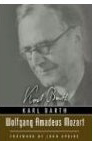
Barth’s devotion to Mozart is well known. He began each day listening to Mozart; he included Mozart in the Church Dogmatics; and he remarked: “if I ever get to heaven, I would first of all seek out Mozart and only then inquire after Augustine, St Thomas, Luther, Calvin, and Schleiermacher” (p. 16). In fact, towards the end of his life Barth even experienced his first and only mystical vision: a vision of Mozart gazing at him benignly from the stage during a concert. (Hans Urs von Balthasar was very impressed by this vision!)

In this little book – originally published in 1956 in celebration of the 200th anniversary of Mozart’s birth – Barth collected some of his various writings and addresses about his beloved Mozart. With wonderful hyperbole, he describes the musical uniqueness of Mozart, suggesting that Mozart’s “characteristic basic ‘sound’” might in fact be “the primal sound of music absolutely” – Mozart “struck this ‘tone’ in its timelessly valid form” (p. 28).

Theologically, too, Barth speaks of Mozart’s utter uniqueness: “In the case of Mozart, we must certainly assume that the dear Lord had a special, direct contact with him” (p. 26). His music “evidently comes from on high” (p. 33) – indeed, Barth “leaves open” the question “whether Mozart could possibly have been an angel” (p. 45).

Above all, it is the dialectical character of Mozart’s music that Barth admires. In this music, everything comes to expression: “heaven and earth, nature and man, comedy and tragedy, … the Virgin Mary and the demons” (p. 34). Mozart simply contains and includes all this within his music in perfect harmony. This harmony is not a matter of “balance” or “indifference” (like the balance of Schleiermacher’s system!) – it is “a glorious upsetting of the balance, a turning in which the light rises and the shadows fall …, in which the Yes rings louder than the ever-present No” (p. 55).

In all this, however, Mozart “does not wish to say anything: he just sings and sounds.” Unlike Bach, he has no doctrine or message, and thus “he does not force anything on the listener …; he simply leaves him free” (p. 37). This note of freedom is what most impresses Barth. “Mozart’s music always sounds unburdened, effortless, light. This is why it unburdens, releases, and liberates us” (p. 47).

As you can tell, this is a beautiful book, important for what it reveals both about Mozart and about Barth himself. But the book would also be well worth getting just for the brilliant foreword by John Updike. Updike rightly highlights the deep affinity between the music of Mozart and the theology of Barth: “Those who have not felt the difficulty of living have no need of Barthian theology; but then perhaps they also have no ear for music” (p. 12).

Wednesday, 6 December 2006

Mozart: the triumph of genius

Jon Pott, Editor-in-Chief of Eerdmans Publishing, has written a lovely essay about the genius of Mozart:

“No composer on earth has inspired more talk about heaven than Mozart. One of his celebrated 20th-century biographers, Alfred Einstein, managed to call him a mere ‘visitor on earth,’ and even Shaw, not a reverent man, opined that the two priestly arias of Sarastro in The Magic Flute were the only music yet written that would not sound out of place in the mouth of God. Whatever the divinizing excesses of such language, Mozart has probably received more attention from theologians than any other composer save Bach.”

Sunday, 28 May 2006

Sunday with Mozart

This afternoon I went to a performance of Mozart’s beautifully intimate Clarinet Concerto, conducted by Werner Andreas Albert.

A Sunday with Mozart is truly a “day of rest.”

Monday, 17 April 2006

Karl Barth’s study

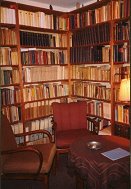
Professor Ray Anderson of Fuller Theological Seminary kindly sent me some pictures that one of his students took while visiting Karl Barth’s home study in Basel. Here they are, for your enjoyment.

The three stages of Barth’s Römerbrief—handwritten, typed and printed.


To the right of the chair, three metres of Mozart books—right between the Church Fathers!


Calvin and Mozart on the same level.

Tuesday, 10 January 2006

Essential compositions for theologians

Our local classical music aficionado, Jim West, has created a list of essential compositions for theologians. Here’s Jim’s comment, followed by his list of 15 essential compositions:

It’s a well known fact that Karl Barth began his day with breakfast, coffee, the newspaper, and Mozart. In my estimation that’s why he was the theologian he was: his wisdom in listening to Mozart each day before he began his work. Productive minds spring from the ground of productive soil. And nothing feeds the mind like excellent music (and it also feeds the soul). So, which compositions are essential for theologians? What are the compositions not only without which theologians cannot do their work, but without which life itself becomes frivolous and empty?

1. Mozart’s Requiem (KV 626)
2. Beethoven’s Ninth Symphony, 4th Movement (Ode to Joy)
3. Michael Haydn’s Divertimento In C Major For Violin, Cello, & B.C. (P99) [3] Menuet
4. Mozart’s Symphony in No. 32 in G major (KV 318)
5. Michael Haydn’s Symphony Number 18
6. Michael Haydn’s Symphony Number 26
7. Mozart’s Clarinet Concerto A Major, (KV 622) - I. Allegro
8. Mozart’s Les petits riens, KV App. 10/299b
9. Johann Christian Bach’s Amadis des Gaules
10. Johann Christian Bach’s Symphony Number 1 in D Major
11. Johann Sebastian Bach’s Brandenburg Concerto Number 5
12. Mozart’s Don Giovanni
13. Mozart’s Le Nozze di Figaro
14. Mozart’s Cosi fan Tutte
15. Martin Luther’s Ein Feste Burg Ist Unser Gott

Monday, 9 January 2006

Another face in my study

A couple of weeks ago I posted some pictures of faces in my home study. Now, thanks to an excellent Christmas present, there is an important new addition:

The greatest of all composers: W. A. Mozart.

Wednesday, 7 December 2005

When a cup of strong coffee just isn’t enough...

I kick start my day with Mozart’s Overture to “The Marriage of Figaro.”

Wednesday, 2 November 2005

Others who love Mozart

Tchaikovsky: “Mozart is the musical Christ.”

Bernard Shaw: Mozart’s was “the only music yet written that would not sound out of place in the mouth of God.”

Charles Gounod: “Mozart exists, and will exist, eternally; divine Mozart—less a name, more a soul descending to us from the heavens, who appeared on this earth, stayed for a little over thirty years, and left it all the more rejuvenated, richer and happier for his appearance.”

Victor Borge: “In my dreams of heaven, I always see the great Masters gathered in a huge hall in which they reside. Only Mozart has his own suite.”

Phil Goulding: “For one moment in the history of music all opposites were reconciled; all tensions resolved; that luminous moment was Mozart.”

Edvard Grieg: “In Bach, Beethoven and Wagner we admire principally the depth and energy of the human mind; in Mozart, the divine instinct.”

Franz Alexander von Kleist: “Mozart's music is so beautiful as to entice angels down to earth.”

Albert Einstein: “Mozart is the greatest composer of all. Beethoven created his music, but the music of Mozart is of such purity and beauty that one feels he merely found it—that it has always existed as part of the inner beauty of the universe waiting to be revealed.”

Georg Solti: “Mozart makes you believe in God.”

Tuesday, 1 November 2005

Theologians who love Mozart

Søren Kierkegaard: “I am like a young girl in love with Mozart, and I must have him in first place, cost what it may.”

Karl Barth: “With an ear open to your musical dialectic, one can be young and become old, can work and rest, be content and sad: in short, one can live.”

Hans Küng: Mozart’s music has “relevance for religion ... precisely through the compositional technique of the non-vocal, purely instrumental music, through the way in which music interprets the world, a way which transcends extra-musical conceptuality.”

Pope Benedict XVI (formerly Joseph Ratzinger): “His music is by no means just entertainment; it contains the whole tragedy of human existence.”

Thursday, 13 October 2005

Mozart’s Violin Concerto No. 2 in D Major

“Forget not to listen unto this: for thereby some have been entertained by angels unawares.”

Wednesday, 10 August 2005

Heaven

Mozart’s Piano Concerto No. 21.

Archive

Contact us

Although we're not always able to reply, please feel free to email the authors of this blog.

Faith and Theology © 2008. Template by Dicas Blogger.

TOPO