Showing posts with label eucharist. Show all posts

Friday, 9 September 2016

A guide dog at holy communion

On the mountain where my parents live, deep in the rainforest, there is an unassuming red-brick chapel where the people go to pray. I went there one Sunday morning, following the winding way through the forest, past the winery and the empty cafés and the smoking chimneys where the villagers still slept nestled among the trees. I parked the car across the street near the old log sign. The organ was playing. A plump of ducks crossed the road in front of me, preening themselves and gossiping amiably like the clucking women who waddled their way into the church. High in the treetops the whipbirds sung their morning antiphons. I stepped over a puddle and went inside.

“The Lord be with you.” The service was led by a white-haired skeleton, profoundly old and happy, a long-retired priest who laboured over the prayerbook, scrupulously working at each syllable and then looking up and beaming deafly at the congregation whenever we replied. “And also with you!”

When we all came forward for Holy Communion I noticed a man I had not seen before. He stepped out from the pew right at the back. He was wearing sunglasses, which would have been strange enough in church, and he had with him a dog, a labrador, who led the man into the line and brought him step by step towards the altar. When they reached the front, the dog sat down and faced the altar while the priest put bread into the man’s hand and raised the cup for him to drink. As soon as the cup withdrew, the faithful dog was on his feet again, gravely leading his master back to the pew. He was a good dog, anyone could see that. He behaved with all the ceremony and propriety that you could ask of someone who has to go to church wearing a collar. He was not himself a believer, not exactly, but he respected the thing for what it was and loved it because he knew, by an unerring instinct, that his master loved it.

After church I met the blind man outside and asked about the dog. He loved the dog and told me how they went to church together every week. For ten years the dog had led him and they never missed a Sunday.

I told him how impressed I was by the dog’s behaviour at Holy Communion. “I have a labrador,” I said, “and he would never have the discretion to wait facing the altar while I took the bread. He would sit there, sure enough, but he would turn his face towards me and his eyes would silently implore me for a crumb of consecrated bread, and then, when I refused, his hopeful eyes would brim with mourning.”

“They are good dogs,” the man agreed. “Their respect for food is very deep. That is why he understands the eucharist. He grasps it not as an idea but in its real depths. It is food. He knows that.”

“Ten years,” I said. “That is five hundred times he has gone with you to the altar.”

“Sometimes,” the blind man said, “I have felt his hunger. There is a holiness in all God’s creatures. The bread is offered in thanksgiving for all that lives.”

I said, “Perhaps in heaven there will be a eucharist for him.”

But the man said, “No, I don’t believe it. There will be no eucharist on the other side, no church or priest, no bread or wine. We have these things now because we need them. But on that day, need will be no more. There will be no sun because the Lamb will be our light. No eucharist, because everything will be thanksgiving.”

Morning found its way belatedly through the trees and we stood there transfigured in the sunlight. The ducks went by again; the dog watched them coolly, with studied indifference. The old deaf priest shuffled up and greeted us one last time and went inside to close the church.

“Besides,” the blind man said as I turned to go. “He has gone five hundred times to church already. He is a working dog. It is the same with him as with a priest: church is work. Whatever else heaven might be for him, it will not be anything that includes spending another solitary second inside a church!”

Maybe he was right, I don’t know. There is no use dwelling on it now. All this was years ago. By now the dog will have retired from active life. By now he will have died. What God thinks of him, no one can say. But I will always remember the way he sat and waited, lovingly facing the altar, while beside him the one he loved stood blessed under the name of God and ate the world’s redemption.

Monday, 17 March 2014

Patristic peculiarities: John Chrysostom and the poison eucharist

This is the start of a new occasional series on some of the more peculiar arguments I've come across in early Christian literature. These are the quirky bits that somehow never made it into the textbooks. 

John Chrysostom, the great fourth-century preacher, described Christ's descent into hell as a kind of poison eucharist. When Christ died, his body descended into the ground. Death ingested his body like food. But this was no ordinary food. It was a fatal poison. It brought on violent stomach cramps, worse (Chrysostom assures us) than the agony of a woman in labour. Death could not digest Christ's body. Death writhed in pain, then vomited: "Like those who take food and vomit it up because they can't retain it, so death vomited. He received the body which he could not digest, and so he had to throw it up again" (all this is from homily 24 on 1 Cor).

But after developing this vomiting image in graphic detail, Chrysostom changes his mind. No, he observes, Christ didn't come back out of the mouth of death. He didn't come out the same way he went in. Death didn't merely vomit; it suffered a massive abdominal rupture. After death had ingested Christ's body – I warn you, this is pretty grisly – it suffered violent convulsions, and then its stomach burst open. Everything came out. Chrysostom is thinking here of the story in Bel and the Dragon, where Daniel killed the dragon by feeding it a concoction of pitch and fat and hair; upon eating this vicious recipe, the dragon's stomach burst open and it died. "For Christ didn't come forth again from the mouth of death, but issued forth from the belly of the dragon, bursting it and ripping it open from within."

Thus the body of Christ proves to be a fatal poison. It destroys death from within. When the stomach of death is violently emptied, it's not only Christ's body that is released. Everything else that death had ever ingested is released as well. The contents of death's stomach are completely emptied. Hell is left empty, and not a single one who died is left in the grave.

And Chrysostom's point? "This is the body that he has given to us to hold and to eat!" These grisly reflections come, after all, in a sermon on the eucharist. Chrysostom is reminding his congregation never to come carelessly or irreverently to the table. "Purify your soul, prepare your mind for the reception of these mysteries!" The same body that poisoned death and emptied the grave is now ingested by the believer. It is the same body, the same potent food. "So," Chrysostom cautions, "let us stir ourselves and be filled with horror." When you come to the table, don't forget what you're about to eat!

"Because of this body I am no longer earth and ashes, no longer a prisoner, but free…. This body, nailed and scourged, was more than death could stand against. The sun turned aside its beams when it saw this body sacrificed. The veil was rent for this body, and the rocks burst open and the whole earth was shaken. This is the very same body!" At the Lord's table we hold this body in our hands. We "kiss" it and "bite it with our teeth." (Chrysostom observes that lovers often nibble each other when they're passionately kissing: in the same way we lovingly nibble the consecrated bread.) Death ingested this body, not knowing that it was eating its own death. The same body is life to us when we eat it. By poisoning and slaying all death's power, this food has become "our hope, our salvation, our light, our life."

Saturday, 19 October 2013

Why go to church?

The children of Adam are emptiness,
the children of men are a fake;
they are set on the scales together,
and emptiness is their weight. 
Psalm 62:9

There are people who say that religion is a crutch, and I have never taken offence at that description. There have been times when I've gone to church feeling the need for personal forgiveness or comfort or strength or whatever. But the older I get – I'm not very old of course, but I'm not quite as young as I used to be either – the more I feel that my faith is not primarily a personal thing but a way of sharing the common lot with everybody else.

I go to church sometimes not needing comfort for my own private griefs but seeking consolation for the slow unfolding trainwreck that is called human history. I go to church sometimes hoping to find forgiveness not for myself but for my ancestors, my parents, my children and their children who will one day be born and will have to live (who knows how?) in whatever diminished world that I bequeath to them. I go to church sometimes not to be reconciled to any of my personal acquaintances, but because for fifty thousand years the land beneath my feet was home to other peoples, and I am hoping by some miracle to be reconciled to them. I go to church sometimes not seeking peace within my own soul but hoping to find relief from the raging violence that has boiled in the blood of all my brothers since the time of Cain.

I go to church and take bread and wine not necessarily because I feel hungry but because the common human condition is, at bottom, hunger and thirst and nothing more. It is the hunger of my mothers and fathers that I am feeding when I take the consecrated bread. When I take the cup it is the burning thirst of Adam that I slake. It is for the whole huge accumulated mass of human arrogance and stupidity and meanness that I hang my head in shame and say (embarrassed to be asking yet again), Lord have mercy.

I do not go to church because it is enjoyable (usually it's not), or because it is never dull (usually it is). I do not go to church because it satisfies my private needs and wishes (it seldom does). I do not go to church for myself. I go because of Adam. 

Yes, religion is a crutch. But it's not my own personal crutch. It is Adam's crutch. It's the human race that walks (if it walks at all) with a limp. 

And so when Sunday morning comes around I drag old Adam out of bed. I make him get dressed and put shoes on his feet. I brush his teeth. I lead him out the door. I force him to go to church. 

It's a thankless task, but somebody's got to do it. 

I expect that if I keep dragging Adam along to church every Sunday, he might eventually become a Christian. And if he becomes a Christian – who knows? – perhaps in time he will even become that rarest and best of things: a genuine, proper, fully functioning and bona fide human being.

Sunday, 6 October 2013

It’s about Him: Kim's farwell sermon

Yesterday Kim turned 65, preached and presided at communion, had lunch with his congregation, and retired from pastoral ministry. This is the text of his last sermon as well as the communion service that followed.

It’s not about me, it’s about him, it’s about Jesus. That is all I have ever wanted to do as your minister: to remind us all – me first – service by service, sermon by sermon, visit by visit, conversation by conversation, in assurance and doubt, in clarity and confusion, in joy and sorrow – it’s about him, it’s about Jesus: his lordship and friendship, his disturbance and consolation, his grace and commands.

Again, I know I have failed you. I always knew I would fail you. Because I don’t think success in this vocation is possible, and even if it were, I don’t know what it would look like (it’s certainly not measureable). Yes, failure is inescapable. In preaching, I know I should have prayed more, thought harder, spoken more clearly. In leading, I know I should have been more assertive here and less directive there, more discerning, more enabling. In caring, I know I should have been there for you in such a way that no one need ever have said, “I’m sorry to bother you, I know you’re busy, but …” In all things, I have failed to decrease so that Jesus might increase, too much Kim and not enough Christ. And for proof that I have failed you – gentle rebuke! – that so many of you are here today because of me, when you should be here every Sunday because of Jesus. Because it’s all about him.

Many years ago I preached a sermon entitled “Who Is Jesus of Nazareth – for Me?” It’s still a good title, especially, I think, for a final sermon. Of course, I’d like to delete the “for Me” because, yep, it’s not about me, it’s about him, but you can’t do that. You can’t do that not only because there is no Jesus-in-general, but also because I cannot know Jesus directly, I can only know him in a mediated way. We always see Jesus through the lenses of the gospels, each with its own particular picture of Jesus; and, in turn, we never read the gospels neat, we always bring with us traditions of interpretation; and, in turn, these interpretations are always conditioned by context and perspective; and, finally, there is me – yep, me again, darn it, always getting in the way – me with my readings of Jesus inevitably distorted by prejudice and fantasy. This side of eternity, our knowledge of Jesus is always correctable, provisional; there is always more to know. Still, Jesus himself confronts us with the question “Who do you say that I am?” And equivocation won’t do, the answer is urgent: Who is Jesus for me today (Bonhoeffer)?

Well, for starters – the present is what the past is doing now – Jesus for me now cannot be other than Jesus who was then. He must be the 30-odd-year-old Jew who lived in first-century Galilee, a Roman colony administered by a local despot, where there was systemic oppression and exploitation, as powerful and wealthy elites used religion to legitimate their place in the social order and violence to protect it. These were very troubled times in occupied Israel. Nazareth, where Jesus grew up, was a small agricultural town, population 400 max. The issues of hunger and debt dominated daily existence. Jerusalem was 70 miles south, population 50,000, swelling to a quarter-million during the Passover festival of liberation. There the high priest and his Temple colleagues collaborated with Caesar’s minions. As for life 24/7, being Jewish, practicing the teachings of Torah and tradition – food laws defining what you can eat; purity laws dealing with the body, its fluids and blemishes; the weekly sabbath, time set apart for worship, rest, and festivity too; all overseen and regulated by the scribes and priests.

This is the world in which Jesus appears, blazing like a comet across the night sky, clapping like thunder on a cloudless day. What was he like? He is the “man who fits no formula” (Eduard Schweizer). The engine room for this human dynamo – his relationship with God, so intimate that, like a child, he calls God Abba. This Abba-experience of Jesus – it is the source and secret of his being, his life-style, his mission, which is to announce the arrival of, and to get people ready for, the “kingdom of God”. And, please, after 31 years, I trust you know that the kingdom of God is not some sanctum within nor a heaven above, know that Jesus did not come to bring us a quiet life, nor to flog fire insurance, that he came as the agent of God’s shalom, the personal and corporate experience of grace as forgiveness, acceptance, and inclusion, of social justice and the common good. God wants it all, God wants it now, and there ain’t nothing going to stop it – this divine invasion – sweeping away all that opposes it, all that inflicts suffering and death, all that murders joy and hope.

But this rainforest of flourishing starts as a seed, starts with 12 ordinary Jews, representing the 12 tribes of Israel: the renewal of the world begins with the renewal of Israel. Jesus is, above all, a teacher, so he tutors the disciples, but he also gives public lectures, and the heart of his teaching is so simple that a child can understand it and so hard that only the empowered can do it. By provocative short sayings and absurdly counter-intuitive stories, Jesus challenges, teases, and shocks us to see the world radically differently from our conventional perceptions, which for Jesus are symptoms of an optical illness. Discipleship thus begins with vision, a vision of this new world that Jesus discloses, which, hidden in our old world, happens to be the real world; a vision that then inspires lives that embody the values of this new world in opposition to the values of our old one, cynical, pitiless, and nihilistic.

You see, because Jesus loves the world, he sifts the world. He has a special compassion for the little, the least, and the lost, and a particular beef with the movers and shakers. Jesus comes in love, not judgement – he is, in fact, the love of God incarnate – but when human beings encounter such divine love, there is a decision to be made and an outcome that follows: either love kills you – you die to self and live for others – or you kill love – which is exactly what the combined forces of church and state do, in the name of law and order of course: love gets lynched.

And that’s it… But no, it’s not! Hooray! Whoopee! God raises his dead Son. The victim turns out to be the victor. The friends of Jesus, who in stupidity and cowardice betray, deny, and abandon him – they re-experience grace as forgiveness. The enemies of Jesus, who in fear and malice torture and execute him – well, in his risen life as in his earthly life, Jesus does not answer his killers with vengeance. Who knows, maybe one day they too will see the world otherwise, disarm, and drink deeply from the love God never ceases pouring into the world like lake upon lake of the finest Shiraz – Jesus likes to liken the kingdom to a never-ending bit-of-a-do!

That, in short, is the Jesus who was and is and is to come, the same today, yesterday, and forever. This Jesus lives for me, with me, and, sinner that I am, often against me. Does he answer all my questions? On the contrary, always with the counter-question, my interrogative Saviour: “You work it out!” Does he keep me from suffering? On the contrary, he says that I should count on it, that discipleship is dangerous, because obedience will likely get me into trouble with the same kind of grace-abusers who finally nailed him. Does he advise me to play it safe and cut my losses? On the contrary, this is the guy who extols a shepherd who endangers his prize lambs to fetch a wayward runt, a father who delights more in his irresponsible spendthrift of a son than in his respectable book-keeping brother, a heretic who risks his life and empties his wallet on the victim of a roadside mugging, and a farmer who pays a bunch of last-in part-timers the same wage as his all-day grafters.

Finally, does he love me? What a silly question! Of course he loves me, and nothing I do can make him love me any more or any less. In prayer he quiets my restless heart, in work he gives me a sense of freedom and purpose to be there for other people, in leisure he tells me to laugh and live it up. And as for the death that stalks me every day and will one day overtake me, he says, “Don’t be afraid!” – death is but the self-expenditure of love – and he promises that because he lives forever, I will live forever too. What more could I want? What more do I need?

And those failures? With my failures he is patient – and more: he gives me a family of failures for company. If it’s not about me, it’s about him, it’s also about us, the church, this gaggle of goofballs. But we are – at least I hope we are – also a community of character that is serious about finding and focussing our life in Jesus, serious about the struggle to speak truthfully about God – so much contemporary God-talk is froth and piffle – and therefore serious about engaging in odd and subversive practices like worship, confession, Communion, Bible study, by which we are nourished and strengthened to live out the Sermon on the Mount, that snapshot of life in that new world coming, of which Jesus is both the promise and the pioneer.

No, it’s not about me, it’s about him; but he’s about us, he’s about everyone!

I’m finished – and famished: the Lord has prepared another Supper for us. As Porky Pig famously stutters at cartoon’s conclusion, “Th-th-th-that’s all, folks!” Or is it? For though we may not recognise it at the time, what is every ending but a new beginning?

*

Service of Holy Communion

THE INVITATION
Are you hungry? Are you thirsty? You’ve come to the right place!
There is plenty of room at this table.
It’s not full until all kinds of people are here:
tall people and short people, portly people and skinny people,
people with rosy cheeks and people with wrinkly skin,
black-skinned and white people, the blond and the bald.
Come, there is room for you. We’ve got the best food –
hearty bread to fill your belly, heady wine to make you sing.
Come, join us – and live.
Let’s eat and drink!

THE PEACE

THE NARRATIVE
People have been breaking bread in the name of the Holy One for centuries.
Our Jewish mothers and fathers blessed bread and wine and shared it.
Christians have gathered around tables and sat on mats
to pass the loaf of love and the cup of kindness.
And generous people have given hospitality to travellers and strangers, fellow pilgrims on the way to the kingdom.
We remember how Jesus shared a meal with his disciples in an upstairs room,
one who would deny him, another who would betray him.
There he took bread, raised it to heaven, and giving thanks to his Father,
broke it with a sound that echoed in his heart, and said:
“This is my body, broken for you. Eat it and remember.”
Then he took the cup, sweet and bitter offering, held it in both hands –
it would not pass – and giving thanks to his Abba, said:
“This is the cup of mercy that will spill all over the world
and open the hearts of many. Drink and remember.”
And they did. And we do. Let us give thanks to God.

THE THANKSGIVING
World-maker, Barrier-breaker, Peace-bringer, Holy God:
In the beginning, You. In the now, You. 
And when time ends, You. Always You!
With a handful of dust you gracefully fashioned us,
shaping us to be signs of your presence on earth.
You gave us the breath of life and placed into our hands the power to create,
into our heads the freedom to think, 
and into our hearts the strength to love.

You gave us all we need to live:
food and drink for our bodies; natural wonders for our senses;
wake-time and dream-time for our minds; and for our souls –
the light of the law, the rod of the prophets, the songs of the psalmists,
and the vision of a just and joyful world.

In the fullness of time the Word became flesh – you pitched your tent among us:
learning and loving, teaching and healing, forgiving and rebuking.
You shook the pillars of power and paid the price –
the lash of the whip, the crown of thorns, the cruel cross.
Death held you briefly, but in three days you burst forth alive,
and the echo of the empty tomb rang around the world.
Risen and reigning, you call us into fellowships of faith seeking understanding,
communities of character, churches in mission.
Your Spirit continues to revive and empower us,
informing, unforming, reforming, transforming.

Now, God, we pray: infuse these gifts of the earth – bread and wine and us –
with your grace and energy.
May our eating and drinking in faith and expectation equip us to share
the good news of your peace with all people and nations,
until the coming kingdom is the kingdom come,
and all rejoice in a new heaven and a new earth.

THE LORD'S PRAYER

THE BREAKING OF BREAD
This bread, earth-grown, hand-made, and heaven-blessed,
is now for us the bread of life.
This cup, fruit of the vine, lifted in love and drunk with courage,
is now for us the wine of salvation.

THE POST-COMMUNION PRAYER
God, our creator, we thank you for the nourishment of bread and wine,
word and worship, family and friends.
Jesus, our brother, we thank you for the way you walk with us,
past comfort, through conflict, toward connection.
Spirit, our breath, we thank you that you call us in to send us out
with strength, commitment, and compassion.
Holy Three-in-One, now may our thanks go from our lips to our living,
human hymns of hope and laughter:
Amen.

(Carla A. Grosch-Miller, much adapted)

Thursday, 5 March 2009

Church and eucharist

“The point of saying that the Eucharist makes the church is that the body of Christ is not a perduring institution which moves linearly through time, but must be constantly received anew in the Eucharistic action…. Because the church lives from the future, it is a thing that is not. The church inhabits a space and time which is never guaranteed by coercion or institutional weight, but must be constantly asked for, as gift of the Holy Spirit. The Eucharist is the imagination of the church, but it is not our imagination in the sense that Christians build the church. The Eucharist is God’s imagination of the church; we participate in that imagination insofar as we imagined by God, incorporated into the body of Christ through grace….

“Eschatology is always in tension with history. This is the church’s story. It is not reactive in the sense that the church is defined and located by the state, or by other narratives external to its own. Opposition to the powers and principalities of the world is written into the very narrative of the death and resurrection of Jesus Christ which is commemorated in the Eucharist.”

—William Cavanaugh, Torture and Eucharist: Theology, Politics, and the Body of Christ (Blackwell, 1998), pp. 269-73. And on a related note, check out this failed gospel tract.

Tuesday, 10 June 2008

The market and the eucharist

“We live our lives at the intersection of two stories about the world: the Eucharist and the market. Both tell stories of hunger and consumption, of exchanges and gifts; the stories overlap and compete…. The call to Christians is not so much either to embrace or try to replace abstractions such as ‘capitalism’ with other abstractions. It is rather to sustain forms of economy, community, and culture that recognize the universality of the individual person…. The Christian is called not to replace one universal system with another, but to attempt to ‘realize’ the universal body of Christ in every particular exchange.”

—William T. Cavanaugh, Being Consumed: Economics and Christian Desire (Grand Rapids: Eerdmans, 2008), pp. 89, 86, 88.

Friday, 21 March 2008

Good Friday

“Love is that liquor sweet and most divine,
Which my God feels as blood; but I, as wine.”

—George Herbert, “The Agonie” (1633).

Sunday, 9 March 2008

Eucharistic tears

At my local parish, young children are allowed to receive the bread at Communion. But this morning our rector was away, and the visiting priest followed the usual Anglican procedure of giving the children a blessing instead of bread. I didn’t really notice this until my family had returned to our pew – when we had sat down, my three-year-old daughter burst into tears and exclaimed loudly: “But where’s my body of Christ?”

Monday, 15 October 2007

Does the eucharist make the church?

Chris has posted an interesting series on this question, and he offers a Reformed critique of de Lubac and Zizioulas.

Thursday, 14 June 2007

Whosoever will

“As it is the Lord’s Supper, Jesus Christ is the host who presides and invites participants to the table…. Insofar as it is Christ’s table, the church is invited, and therefore the church and its officers are not the presiding hosts. The church people who do preside at the table are only the servants who have themselves been invited…. [T]he table is a place of welcoming by God to sinners. When we get too strict about the right intentions, we might tend to lose sight of the fact that we are sinners welcomed to a table we do not deserve and over which we do not preside.”

—Joe R. Jones, A Grammar of Christian Faith (Lanham: Rowman & Littlefield, 2002), 2:673-75.

Wednesday, 9 May 2007

Christianity and capitalism

Over at Journeying with Those in Exile, Dan has been posting a long and challenging series on Christianity and capitalism. He advocates radically “nonsensical” forms of sharing, and in the latest post he highlights the economic significance of the eucharist: “We will have sufficient for all, even the least, as long as we break bread together. What we need to remember is that every time we partake of the Eucharist, we are breaking bread with the global body of Christ, with Christians in the two-thirds world. Thus, after such bread breaking, how can we not also share all things with them?”

Wednesday, 28 March 2007

Sacramentum caritatis

A couple of weeks ago, Benedict XVI released the apostolic exhortation “Sacramentum Caritatis” (Sacrament of Love), which he described as a complement to his first encyclical, “Deus Caritas Est” (God Is Love). In case you haven’t seen this yet, it’s a fascinating and impressive exhortation that deserves a close reading (all 97 paragraphs!) – you can see the full English text here.

Although both Protestants and progressive Catholics will have many reservations with the document, it is nevertheless a beautiful theological and pastoral meditation on the eucharistic mystery. As anticipated, the Holy Father reinforces some of the most problematic aspects of Catholic teaching, such as the necessity of priestly celibacy (§24), the refusal of the eucharist to divorced and remarried persons (§29), and the eucharistic obligation of Catholic politicians to “support laws inspired by values grounded in human nature” (§83). He also advocates the reintroduction of the Latin Mass (§62) with Gregorian chants (§42), as well as a series of more modest (and very sensible) reforms in relation to the offertory (§49), the exchange of peace (§47), and the homily (§45).

The exhortation concludes on a joyful note that reiterates the relation between eucharist and mission: “The Eucharist makes us discover that Christ, risen from the dead, is our contemporary in the mystery of the Church, his body. Of this mystery of love we have become witnesses. Let us encourage one another to walk joyfully, our hearts filled with wonder, towards our encounter with the Holy Eucharist, so that we may experience and proclaim to others the truth of the words with which Jesus took leave of his disciples: ‘Lo, I am with you always, until the end of the world’” (§97).

Saturday, 10 February 2007

Let's have a meal, let's have a feast!

A hymn by Kim Fabricius

(Tune: Truro)

Let’s have a meal, let’s have a feast!
    Come one and all, from great to least:
the food and drink have been prepared,
    the Lord provides and all is shared.

Let’s have a meal, let’s have a feast!
    This table cannot be policed:
it’s not the church’s, it’s the Lord’s,
    it’s spread for free, not for reward.

Let’s have a meal, let’s have a feast!
    From “us” and “them” we’ve been released:
no strangers here, for all are friends,
    no need to hide, deride, defend.

Let’s have a meal, let’s have a feast!
    Join hearts and hands, and pass the peace:
Christ turned the cheek and walked the mile,
    now all to each are reconciled.

Let’s have a meal, let’s have a feast!
    Let grace abound, let joy increase!
And as we take the bread and wine,
    let who we are be re-defined.

The bread and cup

“[W]hat the bread and cup as visible words specifically say, is precisely something about the embodiment of Christ in the life of the church. That Christ is indeed present as body, that he is not in our midst as a disembodied pure spirit, is itself an essential part of the gospel proclamation. If Christ were not present in the body, every gospel-address would be false.”

—Robert W. Jenson, Visible Words: The Interpretation and Practice of Christian Sacraments (Philadelphia: Fortress, 1978), p. 107.

Thursday, 18 January 2007

The eucharistic event

“The eucharistic event, as a movement from absence to presence, is as such a movement from chaos to order, darkness to light, death to life. It is an inventive, ordering event on the same plane as the act of creation, though its actual results are largely withheld from our view.”

—Douglas Farrow, Ascension and Ecclesia: On the Significance of the Doctrine of the Ascension for Ecclesiology and Christian Cosmology (Edinburgh: T&T Clark, 1999), p. 5.

Monday, 25 September 2006

David F. Ford on the eucharist

In the eucharist, “the realm of the ordinary has been taken up and involved in the most momentous events without rejection, contrast or competition between the two. There is no middle ground needed, no mediating of the ordinary to the extraordinary. The God who is implied by the blessing of these elements is at home with matter and its routine usage as well as with the climactic drama of Jesus’ life. This integrates the sphere of the ordinary with the historically significant.”

—David F. Ford, Self and Salvation: Being Transformed (Cambridge: Cambridge University Press, 1999), p. 150.

Friday, 24 March 2006

Robert W. Jenson: Trinity, time and sacrament

The excellent online journal, Journal for Christian Theological Research, has just released a new article: Jason M. Curtis, “Trinity, Time and Sacrament: Christ’s Eucharistic Presence in the Theology of Robert W. Jenson.” Here’s an abstract:

Some of Jenson’s most stimulating theological themes are those surrounding his trinitarian ontology, where he combines a thoroughgoing knowledge of the tradition with biblical exegesis and philosophical reasoning. What emerges is a trinitarian theology dominated by the concern to overcome any vestige of divine timelessness and replace it with a biblical doctrine of the God who is temporal, yet overcomes temporal contingencies. The manner in which he does this is to link the divine identities with the temporal “moments,” and by maintaining the priority of the future over the past. I argue that this move bears directly upon his view of Eucharist and forces it in a direction that is problematic, namely, that Christ’s presence must be temporally—and by consequence, physically—located.

Sunday, 19 February 2006

Ecumenical colloquium in Durham

Last week an international colloquium of 140 senior church leaders and theologians from the Roman Catholic, Anglican, Orthodox and Methodist churches met for six days at Durham University.

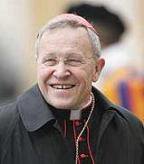
In the keynote address, the Roman Catholic Cardinal Walter Kaspar (pictured) stressed that “unity is symphonic”; unity in the New Testament is “unity in the diversity of charisms, offices, local churches, and cultures.” It is “communio sanctorum, that is, shared participation in the holy, in the life of God, in the Holy Spirit, in the Gospel, in the one baptism, and in the one eucharistic body of the Lord.”

On the first full day of the colloquium, N. T. Wright presided and Cardinal Kasper preached at an Anglican eucharist, and then Wright preached at a Roman Catholic eucharist the following day.

Catholic theologian Eamon Duffy described the colloquium as the most remarkable event in living memory. And N. T. Wright described it as theologically “jaw-dropping.” He remarked: “There are very serious voices within the Roman Catholic Church saying we are not three or four different Churches; we are all part of the one single Church which has some serious internal problems to be addressed. That’s a very different way of stating the ecumenical jigsaw than we have been used to.”

Other participants of the colloquium included Mario Conti, Terence Brain, Kevin Dunn, Michael Evans, Joseph Famerée, David F. Ford, Bernd Hilberath, Linda Hogan, Fergus Kerr, Nicholas Lash, Hervé Legrand, Andrew Louth, Paul McPartlan, Paul Murray, Brian Noble, Patrick O’Donoghue, Ladislas Örsy, James Puglisi, Thomas J. Reese, Stephen Sykes and Mary Tanner.

For further details of the colloquium, see the reports here and here.

Tuesday, 6 December 2005

Towards Eucharistic community

Back in 1998, the brilliant Lutheran theologian Eberhard Jüngel gave an address on Eucharistic community at the German Katholikentag. The address was translated this year and published as “Church Unity Is Already Happening: The Path Towards Eucharistic Community,” Dialog: A Journal of Theology 44:1 (2005), 30-37.

Jüngel models a theologically robust form of ecumenical dialogue in which confessional differences are not ignored or brushed aside, but are taken with full seriousness, and are analysed sharply so that a better understanding can be achieved.

In this address, Jüngel notes that the division between Catholic and Protestant communities “is and remains an ecclesiological scandal, to which the only legitimate scandal, the word of the cross, must put an end” (p. 36). Focusing on the Eucharist as an event of the gospel, Jüngel notes that in the Eucharist there is “no law which would demand human activities or human works,” but rather there is “simply the gospel itself, the gospel that presents to us the salvific action of the death of Jesus Christ” (p. 32).

Archive

Contact us

Although we're not always able to reply, please feel free to email the authors of this blog.

Faith and Theology © 2008. Template by Dicas Blogger.

TOPO