Showing posts with label ecumenical. Show all posts

Monday, 6 June 2016

Review of Donald Norwood, Reforming Rome: Karl Barth and Vatican II

Donald W. Norwood, Reforming Rome: Karl Barth and Vatican II (Eerdmans, 2015)

This is a timely book. Indeed as Donald Norward had been hatching it long before Jorge Mario Bergoglio became Pope Francis in 2013, it is a prophetic book. Unitatis Redintegratio, the Second Vatican Council’s Decree on Ecumenism, states: “In its pilgrimage on earth Christ summons the church to continual reformation, of which it is always in need, in so far as it is an institution of human beings here on earth.” Yet after nearly fifty years this promising declaration seemed, to many an ecumenical Simeon, to have become a forlorn hope. Then, suddenly, habemus papam whose agenda actually includes – “reforming Rome.” (Well, at least the Roman Curia!)

At 232 pages of text Reforming Rome is not a long book, but its 25-page bibliography is suggestive of its compact comprehensiveness. It is hugely instructive and illuminating about Vatican II, not only in terms of input and output, but also as an event. That is, it not only provides a description and analysis of the Council’s work, it also gives a vivid sense of the Council as a kind of huge ecclesial gala for gift-exchange, as much about relationships as ideas. How delightfully Norwood weaves into his narrative snippets of the personal interactions of members and guests, before and after the Council as well as during it. Thus Vatican II becomes a model for the way to do our ecumenism today: unity-through-friendship. Which doesn’t mean that we must always be nice to each other, let alone agree with each other, but it does mean that we will always have each other’s backs.

Enter the ever polemical Karl Barth. From the first volume of his Church Dogmatics when he (in?)famously declared that the analogia entis, the ontological foundation for doing natural theology, is “the invention of Antichrist,” Barth was always up for a theological punch-up with Rome. Until the (school) bell, that is, when many of his Catholic interlocutors became beloved companions (particularly the two Hanses, Urs von Balthasar and Küng). Indeed for all his tenacious cross-examination of the Council’s documents – he lamented the failure of Nostra Aetate “to set forth an explicit confession of guilt” for the Church’s historic anti-Semitism; dubbed Dignitatis Humanae a “monstrosity”; and remained underwhelmed by even the moderated Mariology of Lumen Gentium – Barth was a dedicated evangelist for Vatican II, convinced in his dotage that there were now no “irreconcilable differences” to block the eschatological not-yet of unity from becoming ever more realised.

Other areas of contemporary as well as historical interest covered by Norwood – “The past is not dead; it is not even past,” wrote William Faulkner – include the excellent section devoted to the question of women (Barth told Rome that it still has work to do; women told Barth that he still has work to do too!); an update on why the doctrine of justification by faith should no longer be considered a church-dividing issue (though in my view the 1999 Catholic-Lutheran Joint Declaration on Justification by Faith might be even more of an ecumenical game-changer had insights from the “New Perspectives on Paul” on the ecclesiological import of the doctrine informed the biblical studies done by its working party); and the parts that touch on polity, hierarchy, and the purple elephant that won’t leave the building, i.e., episcopacy (Barth, I sense, would support the ecumenical consensus about the threefold ministry, as long as there are laocratic checks and balances to the exercise of episcopal authority).

Reforming Rome is a must-read for anyone interested in Vatican II, in Karl Barth, and for all engaged in current ecumenical discussions, not least for the contagiousness of the author’s unquenchable enthusiasm for visible unity. In the book’s acknowledgements, Donald Norwood writes that “without the support of my lovely wife Margaret, I could not write another word.” To which uxorial praise I would only add: Margaret, stay healthy!

First published in the Society for Ecumenical Studies Journal

Sunday, 4 May 2014

Church attendance manual (2): singing

Each Christian tradition has its own special attitudes towards singing. When attending a service, it is vital to understand these attitudes in order to avoid the dreaded liturgical faux pas. Mistakes where singing are concerned can incur grave ecclesiastical penalties. The visitor who sings like a Pentecostal during a Presbyterian service will run the risk of being escorted from the premises and given a referral to a clinical psychologist; while the one who sings like a Presbyterian during a Pentecostal service will be regarded as an infidel and may therefore become a target of Friendship Evangelism; this can lead in turn to ten pin bowling, dating, and then eventually marriage and who knows what else. Such misfortunes can easily be avoided if one takes care to observe the following liturgical rules:

Presbyterian
What to do: Let your singing be tempered by a manly soberness and austerity, as if you were respectfully singing somebody else's national anthem. Let your lips remain thin, your body erect, and your hands at your side where everyone can see them.
What to think: As a matter of fact, I'm not 100% certain of the doctrinal correctness of this verse. I'd better mumble the words just to be on the safe side.

Pentecostal
What to do: Let your depth of feeling be inversely proportional to the depth of meaning in the lyrics. Too much meaning = boring. "I'm coming back to the heart of worship" = very intense. The singing must also be done with the aid of an exceptionally talented band.
What to think: I'm not thinking, I'm worshipping.

Evangelical
What to do: You should sing all the Pentecostal songs, but sing them as if you were a Presbyterian. This means you get the best of both worlds: you can sing songs that don't mean anything while feeling nothing at the same time.
What to think: I thank you, God, that we are not like those Pentecostals. (Especially the part about the talented band.)

Roman Catholic
What to do: Don't even bother opening the hymn book.
What to think: Hymns? You can't expect Vatican II to be right about everything.

Anglican
What to do: Same as above.
What to think: On second thought, I should probably open my hymn book.

Orthodox
What to do: Same as above. Except that there is no hymn book. And no hymns really.
What to think: Is this another hymn? I wish there were some kind of hymn book. I guess I'll just keep belting out "Kyrie eleison" every twenty seconds and hope for the best.

African American church
What to do: Sing! Sing like your life depended on it! Sing till your heart cracks and your eyeballs sweat and your great grandmother taps her bony foot in the grave.
What to think: Anything worth singing once is worth singing forty times over. 

Quaker
What to do: Same as above. (Just kidding. Don't even think about it.)
What to think: Think whatever you like, as long as you keep it very Zen.

Fresh Expressions
What to think: Singing is a culturally relative and outdated form of religious expression. We don't do that kind of thing around here because we wouldn't want to create unnecessary obstacles or to make anybody feel uncomfortable.
What to do: Put the latest Matt Redman album on your iPod and listen to it very prayerfully on the way to church. But never tell a soul. (If anyone asks, tell them it's U2.)

Progressive
What to think: Same as above.
What to do: Step 1: Change the lyrics to remove all references to God. Step 2: Resume singing like a Presbyterian.

Sunday, 6 April 2014

Church attendance manual (1): arriving late

Upon arriving late for church, it is important to follow the appropriate Liturgical Rules for latecomers. These rules vary from church to church. There is no single "Christian rule" for late arrivals. In fact, the lack of uniformity on this matter has been a major obstacle to ecumenical relationships. To follow the Pentecostal Rule upon arrival at a Catholic mass, or the Anglican Rule upon arrival at a Presbyterian service, would generally be considered a serious liturgical indiscretion.

In 1948 the World Council of Churches proposed to establish a Commission on Late Arrivals. However, plans were abandoned when it became apparent that the representative churches were unable to agree on a definition of the word "late". A prominent Greek Orthodox delegate argued that "lateness" designates arrival more than twenty minutes after the specified starting time; while several Presbyterian theologians insisted that "lateness" technically refers to any arrival less than three minutes prior to starting time. These thorny and intractable questions of definition perhaps belong more to the philosophy of time than to liturgical studies, and as a result I make no attempt to resolve them here. The following ecumenical manual has been prepared simply as a general guide to the differing Liturgical Rules for late arrivals in various church traditions. It is hoped that this manual will lay the foundation for further study in this field, and that it will prove useful as a practical aid for those emergencies of punctuality that can strike even the most conscientious of churchgoers.

Roman Catholic
What to do: Make your way to a seat promptly but discreetly. Before joining in the liturgy you must do a quick spiritual catch-up. This involves several seconds of kneeling. Anywhere between five and eight seconds is acceptable (less than five seconds would be disrespectful; more than eight would be a mark of pride or fanaticism). Under no circumstances may you join in the liturgy until this catch-up has been performed.
What to think: "Honestly though, it really doesn't matter if I'm late as long as the priest is on time."

Anglican
What to do: Same as the above, except that the spiritual catch-up is performed in an attitude of mild-mannered English contrition. You are not only catching up, but are also expressing regret for having behaved in a discreditable way.
What to think: "I am ashamed for being late, but not as ashamed as I look."

Presbyterian
What to do: If you enter while someone is saying a prayer, you should stand just inside the doorway like a soldier at attention. You may not relax this posture until the prayer is ended, at which time you should march briskly all the way to the front row and sit down, head held high. You are not Catholic; you have nothing to be ashamed of.
What to think: "Even lateness can be a virtue when it is done decently and in order."

Orthodox
What to do: It is easy to make yourself inconspicuous as long as you arrive during those parts of the service (i.e., nearly all of it) in which everyone is milling about. Kiss the icon as quick as you can and try to blend in. Maintain a deadpan expression so as not to attract attention. If for any reason you have to enter while everybody is standing still and paying attention – during the Gospel reading, for example – it is probably better to stay outside and smoke another cigarette while you wait for the milling-about to resume.
What to think: "I wonder if Michael and Eleni will be coming for lunch today. I forgot to check if we have enough wine. I ought to stop by for a few bottles on the way home. Four bottles, just to be safe."

Evangelical
What to do: Stroll in, look around amicably, give somebody a high-five, greet a few people and exchange remarks about sports while you are looking around for a seat. Sit down, put your feet up, and check your phone for messages before joining in the next song.
What to think: "I wonder if anyone will notice if I stick my gum under this chair."

African American church 
What to do: Park your car. Sit there for a few moments contemplating the looks you will receive when you come in late. Think about what you've done. What would your mother say if she could see you now? Then start the engine and drive straight home again.
What to think: "I will probably go to hell for this."

Messy Church
What to do: If the other kids have taken all the crayons, reach across and grab the ones you want. You can also push one of the smaller kids out of his chair if you want to sit there. But don't try pushing Jack's little brother or he might start trying to bite you again.
What to think: "If that girl doesn't give me the blue crayon, I'm going to kick her in the shins. My picture of Jesus is going to be the best."

Pentecostal
What to do: The important thing is to demonstrate your spiritual vitality as you make your way to your seat. Sing with boisterous abandon as you walk, give your arms a little wave, shoot a few joy-of-the-Lord smiles at other worshippers as you pass them in the aisle. Upon taking your seat, it is also permissible to speak loudly in tongues for a few seconds, or to call out hallelujah, as a way of formally announcing your arrival.
What to think: "I'm only late because I was doing something even more spiritual before I got here."

Progressive
What to do: Whatever you feel like. There is no difference between this church service and any other gathering of like-minded individuals. 
What to think: "I think that woman is looking askance at me. Is it because I'm arriving forty minutes late? Some of these people still haven't freed themselves from their old institutional hangups. I'm sick of being treated like this. I really need to find a more inclusive community."

Fresh expressions
What to do: Come on in, pour yourself a coffee, give someone a hug, find an armchair, make yourself comfortable, update your Facebook status on your phone. Then greet everyone and begin to lead the service.
What to think: "I am late in order to challenge stereotypes and to get people out of their comfort zones."

Monday, 15 October 2007

Theology essay competition

Jason alerts us to the World Council of Churches’ essay competition for theological students and young theologians. If you want to enter, you have to write about Prospects for Ecumenism in the 21st Century.

Monday, 28 May 2007

New series: encounters with tradition

Understanding the function of tradition remains a central task for theology today – and ecumenical progress requires an ever deeper understanding not only of one’s own tradition, but also of the internal “grammar” of other Christian traditions. But this is by no means easy. Indeed, as Gerhard Ebeling once remarked, relatively few Christians have ever had to made a real choice between traditions – in most cases, one’s own tradition simply maintains its own powerful self-evidentness in contrast to all other traditions.

Ebeling’s observation highlights the complex difficulties surrounding ecumenical understanding: if I have never encountered (say) the Roman Catholic tradition as a genuine possibility for faith, and so have never had to choose between this possibility and the possibility of my own tradition, then I’ve not yet really begun to understand the Roman Catholic tradition at all.

For this reason, we can learn a lot from people who have made a transition from one Christian tradition to another. Such people have experienced tradition itself – they have encountered both the non-self-evidentness of their own tradition, and the attractiveness and coherence of another tradition. So if we listen to the stories of people who have made such ecclesial transitions, it’s possible that the function of tradition will become a little more translucent, a little more thinkable.

With that in mind, we’re starting a new series here at F&T, entitled “Encounters with Tradition.” The series will feature guest-posts from several people who have made a transition from one Christian tradition to another – from Protestant to Catholic, from Baptist to Anglican, from evangelical to post-evangelical, and so on.

Perhaps these stories of diverse “encounters with tradition” will help us all to encounter our own (and other) traditions in a fresh way.

Tuesday, 27 February 2007

Ten propositions on ecumenism

by Kim Fabricius

1. To adapt a famous saying of Emil Brunner, the church exists by ecumenism as fire exists by burning. Church unity is not an optional extra, or AOB on the parish or presbytery agenda, or a responsibility that can be delegated to the ecumaniacs, it is integral to MOAB, the ministry of all believers. Ecumenism is not an ecclesial suggestion, it is a dominical command.

2. In the Farewell Discourse in John, Jesus asks the Father to sanctify his disciples in the truth as he sends them into the world. Then he prays: “I ask not only on behalf of these, but also on behalf of those who will believe in me through their word, that they may be one. As you, Father, are in me, and I am in you, may they also be in us, so that the world will believe that you have sent me (John 17:20-21). The ecumenical imperative is inherent in the missionary imperative. How can the church, with integrity, proclaim shalom to the world when we are not a truly catholic koinonia? And our catholicity must be recognisably visible; a merely “spiritual” unity is a form of ecclesial docetism.

3. And speaking of koinonia and shalom: consider the cases of Martin Niemöller and John Howard Yoder. Niemöller said, “Because I was an ecumenist, I became a pacifist,” while Yoder observed that the ecumenical movement has its roots not only in the mission field but also in the peace movement. However my intention is not only to draw attention to the connection between unity and non-violence, my more general point is this: orthopraxy should be as integral to the ecumenical project as orthodoxy. After all, in the New Testament unity in ethics is no less central than unity in doctrine. Faith and Order Departments are not the only bureaus in our ecumenical instruments.

4. Nor can faith and order issues be reduced to a checklist where churches tick the boxes. Which leads to the question: Do you think of Christian unity primarily in terms of consensus to be reached, or koinonia to be received and witness to be shared? If the former, it would not be surprising if you were indifferent to ecumenism – indeed you would be right to be so: unity-as-consensus is always but a hair’s breadth from a kind of works righteousness. We are called not to agree with each other but to love one another.

5. We are called to be one because God is one. But the one God is Trinity: that is why unity cannot mean uniformity. The watchword of ecclesial diversity can sometimes give the impression that it is simply a tactical ploy to appease Christians who value freedom of conscience and fear centralised authority. On the contrary, it issues from the very nature of God. And scholars as denominationally diverse as Ernst Käsemann, James Dunn, and Raymond Brown confirm that “there is not just a narrow stream of faith in Jesus in the New Testament, but a great wide river of many currents” (Jean Mayland). There are, of course, limits to acceptable diversity, but I would suggest that they lie within the parameters of: (a) a common baptism, (b) a Trinitarian confession of faith, and (c) a belief in Christ crucified and risen as Lord and Saviour. All else, I suggest, is adiaphora – particularly matters of polity. Moreover, it would be unreasonable to expect more agreement between our churches than we accept within our churches.

6. And episcopacy? There is no question about espicopé (oversight) as such. The question is mono-episcopacy. The question is complicated by what John Webster rightly calls “naïve” accounts of apostolic succession – “their incapacity to envisage the history of episcopacy as political and ideological.” And non-episcopal churches, of course, cannot accept that mono-episcopacy is the esse of the church – the ascended, ruling Christ alone, the one high priest (Hebrews) and έπίσκοπος of our souls (I Peter 2:25), is the esse of the church. But that does not prevent us from being open to mono-episcopacy as the practical, rather than constitutive, bene esse of the church, along the lines of what Calvin called “convenience”, and what we might call “practical reason”. The crucial question is: does mono-episcopacy best witness to the ministry of Christ in his church, and best serve the apostolic project of missio Spiritus? Anglicans and Lutherans – as well as non-episcopal churches! – have recently shown some movement on questions concerning the nature of episcopacy and the reconstruction of the episcopate. Of course if Rome pursues the Frank Sinatra school of ecumenism – “I did it my way” – the future is bleak. But you know the old saying: At the next Vatican council the bishops will bring their wives – and at the one after that they will bring their husbands!

7. An even more promising suggestion that relativises the issue of mono-episcopacy comes from the 19th century Wesleyan ecclesiologist Benjamin Gregory. Commenting on the visit of Peter and John to new Christian communities in Samaria (Acts 8), Gregory observed that “whenever they found the work of the Spirit, the apostles lost no time in recognising, receiving, and connecting that which had been established independently of their own initiative.” Which insight leads Gregory to what the Methodist theologian David Carter calls a doctrine of apostolic recognition: namely, that “it should be the duty of the leaders of any church that claims ... a genuine apostolic continuity to recognise the preservation ... of Christianity under whatever forms and structures it may find.” And a doctrine of apostolic recognition, it seems to me, entails, at least, a generous approach to eucharistic hospitality. As Paul tells the divided church at Corinth, it is not because there is one body that there is one loaf, just the reverse: because there is one loaf, there is one body. The fraction prohibits faction. Ultimately, apostolic recognition rests on the acknowledgement that our unity is in Christ alone.

8. Of course it is not only conservative Catholics who can frustrate ecumenical initiatives, conservative evangelicals can be equally obstructive. The card they usually play is that truth trumps unity, and they are fond of citing Ephesians 4:15ff. George Caird, however, comments on “speaking the truth in love”: “Paul is not recommending frankness of speech tempered by consideration, nor is he suggesting that the claims of truth and love must be held in some sort of tension. There is no Christian truth which is not ‘rooted and grounded in love’, and love is the only legitimate test of men’s adherence to the truth of the gospel.... Those who perpetuate the divisions of Christendom on the grounds of their loyalty to truth can draw no support from this epistle.” Or as I once heard a Catholic theologian expound I Corinthians 13: unity of charity trumps unity of faith.

9. In my view, perhaps the greatest obstacle to an ecumenical future is the refusal to acknowledge our anti-ecumenical pasts. Catholics have killed Protestants, and Protestants have killed Catholics – indeed Protestants have killed other Protestants. I submit that progress in unity will be a pseudo-progress, a movement in historical denial, unless we engage in specific, collective, and mutual acts of penitence, forgiveness, and pledges of “Never again!” Only with the healing of memories can the church proceed in a pilgrimage of hope and promise. And, of course, repentance, recognition, and reconciliation are only staging posts on the ecumenical journey: there is an elephant in the caravan and its name is Israel. And journey’s end is the whole οίκουμένη.

10. Finally, a confession: I am part of the ecumenical problem, not its solution. The fact of the matter is that ecumenical work always seems to depend on church leaders, the men at the top – and they usually are men – working at the national or international level, while Christians at the grassroots are marginalised and patronised. Moreover, our discussions tend to focus on deracinated ideas, divorced from their social location and unrelated to questions of ideology and power. They are also often off the pace of hermeneutical developments – and, crucially, contemporary biblical theology. The recent Common Statement by Lutherans and Roman Catholics on the doctrine of justification, for example, “ecumenical breakthrough” though it may be, takes little account of the “new perspective on Paul” that has been reconfiguring New Testament studies since the 1970s. Dogmatic theologians are now rightly expected to be fluent exegetes; we should expect no less from ecumenical theologians. With regular, informed, and prayerful meeting around the Word in local communities, dry bones may yet be knit together and live.

Postscript: A Joke
The Trinity were discussing their upcoming holidays. The Father said, “I think I’ll go somewhere in Africa this year: they’re still so patriarchal there.” The Son said, “I’m going to Jerusalem again: they seem to like me there, and I get such good service.” “What about you?” the Father and Son asked the Spirit. The Spirit replied: “Rome: I’ve never been there before.” [For Rome, feel free to substitute Geneva, Wittenberg, Canterbury, Constantinople, etc.]

Thursday, 15 February 2007

Timothy George: God the Holy Trinity

Timothy George, ed., God the Holy Trinity: Reflections on Christian Faith and Practice (Grand Rapids: Baker, 2006), 175 pp. (with thanks to Baker Academic for a review copy)

This little volume draws together nine papers originally presented at a Beeson Divinity School symposium on the Trinity. The papers, edited by Timothy George, represent a wide range of ecclesial traditions: Roman Catholic, Eastern Orthodox, Anglican, Baptist, Holiness, and Presbyterian. The collection aims not at conceptual discussion of trinitarian theology, but rather at elucidating the relationship between that doctrine and the concrete life of Christian faith and worship. Thus the crucial question addressed is: “How does the doctrine of the Trinity shape the ways of the Christian life, its worship and prayer, its service and mission?” (p. 13).

In the opening paper, Alister McGrath emphasises the fundamental mystery of trinitarian dogma: “The doctrine of the Trinity represents a chastened admission that we are unable to master God” (p. 20). McGrath thus wonders whether some contemporary trinitarian thought has become too speculative and too detached from the witness of Scripture. His target here is especially social doctrines of the Trinity, which leave one “with a sense of bafflement” at how “a series of rather ambitious social and communitarian doctrines [can be deduced] from the mystery of the Trinity” (pp. 31-32). In contrast, McGrath follows Robert W. Jenson in arguing that the doctrine of the Trinity “identifies and names the Christian God,” so that the doctrine functions as “an instrument of theological precision, which forces us to be explicit about the God under discussion” (pp. 33-34).

McGrath’s paper sets the stage for the rest of the collection, since the remaining essays focus on the significance of the Trinity for the concrete practices and experiences of Christian faith. Gerald Bray argues that the doctrine of the Trinity did not arise from philosophical speculation in the early church, but “from the realities of Christian spiritual experience” (p. 55); and James Earl Massey offers a fascinating account of the underlying trinitarianism of the African-American spirituals. Avery Dulles emphasises the ecumenical significance of the concept of the divine processions of the Son and Spirit, while J. I. Packer gives an account of John Owen’s Puritan trinitarian piety. Timothy George highlights the significance of the doctrine of the Trinity for inter-faith dialogue between Christianity and Islam, and Ellen Charry seeks to revive the notion of the divine perfections by emphasising their practical and soteriological significance.

The most enjoyable chapter, however, is Frederica Mathewes-Green’s reflection on Rublev’s icon of the Trinity. Mathewes-Green is a popular Eastern Orthodox writer rather than a theologian; but she offers a beautiful, concise meditation on Rublev’s depiction of the Trinity. As in much iconography, Rublev “distort[s] perspective in order to give us a sensation that the scene is bursting out toward us, with the chalice in the center pressing itself our way”; as the scene rushes towards us, this distorted perspective gives us a sense “of being off-balance in an unfamiliar, powerful world” (p. 89). Most significantly, though, Mathewes-Green observes that none of Rublev’s three figures is speaking: “The tranquillity of their silence is sufficient” (p. 90).

Finally, the volume closes with a moving sermon by Cornelius Plantinga: “From all eternity inside God, inside the mystery of God …, the Father and the Son and the Holy Spirit make room for each other, envelop each other, call attention to each other, glorify one another. It is the ceaseless exchange of vitality, the endless expense of spirit upon spirit in eternal triplicate life. The only competition in glory of this kind is to outdo one another in love” (p. 155).

Monday, 15 January 2007

The question of Catholicism

“I would like to ask in all seriousness whether Protestantism can be a real answer to anyone for whom Catholicism has never been a real question – whether we still have any real business with the church of the Reformation if in the meantime we have left alone the counterpart with which it struggled. And I would like to issue a warning of the unhappy awakening which might some day follow such detachment. Those who know Catholicism even a little know how deceptive its remoteness and strangeness are, how uncannily close to us it really is, how urgent and vital the questions it puts to us are, and how inherently impossible is the possibility of not listening seriously to those questions once they have been heard.”

—Karl Barth,“Der römische Katholizismus als Frage an die Protestantische Kirche,” in Vorträge und kleinere Arbeiten 1925-1930, ed. Hermann Schmidt (Zurich: TVZ, 1994), p. 313.

Saturday, 2 December 2006

Michael Pomazansky: Orthodox Dogmatic Theology

Michael Pomazansky, Orthodox Dogmatic Theology: A Concise Exposition, 3rd edition (Platina: St Herman of Alaska Brotherhood, 2005), 434 pp. (with thanks to the publishers for a review copy).

Michael Pomazansky’s Orthodox Dogmatic Theology (available now in a third edition with extensive new footnotes) has long been a significant textbook of conservative Orthodox theology. Pomazansky was born in western Russia in 1888, and he studied at the pre-revolutionary Kiev Theological Academy from 1908 to 1912. He served as a theologian and missionary in Russia and then, after the revolution, as a priest and editor in Poland and Germany. In 1949 he moved to the Holy Trinity Monastery in Jordanville, New York, where he remained until his death in 1988 (just days before his 100th birthday!).

For Western Christians, encounters with Orthodoxy can be a bewildering experience. As Georges Florovsky once remarked, while Catholics and Protestants speak a similar language, there is fundamentally no “common universe of discourse” between East and West. This does not mean that understanding is impossible – but it explains the great difficulties involved in such dialogue, and it helps to account for the comparatively slow progress of ecumenical understanding between East and West.

In Orthodox Dogmatic Theology, Pomazansky himself is more or less closed to Western influences: he refers to Catholic and Protestant ideas only where a polemical point is in order; and much of the book is concerned with implicit or explicit controversy with more liberal Orthodox theologians like Vladimir Soloviev and Sergei Bulgakov.

In spite of this, however, Pomazansky’s work provides valuable insight into the distinctiveness of Orthodox dogma in contrast to Western patterns of thought. Indeed, Pomazansky is at his best when he is engaged in critique of Catholic dogma (see for instance pp. 89-93 on the Filioque), or when he explains that an apparent similarity between Eastern and Western views is in fact masking a much deeper divergence.

His criticisms of “legal” patterns of thought in Western doctrine are especially incisive (and, to my mind, essentially correct). He rightly critiques Western doctrines which define redemption as “satisfaction of wrath,” for instance (pp. 213-15); and in an excellent chapter on sin, he criticises the Western tendency towards a “very legalistic, formal” doctrine of original sin and inherited guilt (pp. 162-69). Again, in a very fine discussion of Mariology (pp. 189-97), he notes that the Catholic dogmas of the immaculate conception and the assumption are logically derived from a misleadingly forensic doctrine of original sin.

In contrast to more progressive tendencies in modern Orthodox thought, Pomazansky’s is a highly conservative theology. Indeed, his entire conception of the theological task is one of conservation: dogmatics consists in “the confirmation in the consciousness of the faithful of the truths of the faith which have been confessed by the Church from the beginning” (p. 46), so that it is out of place to reveal “new aspects” or “new understanding[s]” of dogma (p. 47). Indeed, dogma itself cannot “develop,” since there is simply “nothing to add to the teaching of faith handed down” (p. 355). From a Protestant perspective, of course, one could easily connect such themes to a certain conception of divine eternity and immutability: “For God there is neither past nor future; there is only the present” (p. 67); “God is perfection, and every change … is unthinkable” (p. 72).

Nevertheless, even such conservative emphases give expression to the depth and beauty of theological reflection, for, in Pomazansky’s view, “theologizing is not an abstract mental exercise, … but a dwelling of one’s thought in Divine truths, a directing of the mind and heart towards God” (p. 48). And in its best moments, Pomazansky’s work is indeed characterised by a spirit of reverence and adoration – something one does not always encounter in a typical wissenschaftlich work of Protestant dogmatics! To believe in God, Pomazansky writes, means “not only to acknowledge God with the mind, but also to strive towards Him with the heart…. Christian faith is a mystical revelation in the human soul. It is broader, more powerful, closer to reality than thought” (p. 53).

Admittedly, one can find more exciting and more creative Orthodox thinkers – Lossky, Schmemann and Meyendorff, for instance; or, more recently, John Zizioulas and David Bentley Hart. But for a sober, serene and straightforward exposition of Byzantine dogma, Pomazansky’s Orthodox Dogmatic Theology remains valuable and instructive.

Tuesday, 14 November 2006

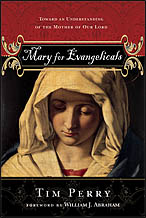
Tim Perry: Mary for Evangelicals

Tim Perry, Mary for Evangelicals: Toward an Understanding of the Mother of Our Lord (Downers Grove: IVP, 2006), 320 pp. (with thanks to IVP for a review copy)

Since Vatican II, we have seen remarkable developments in ecumenical understanding between Roman Catholics and Protestant evangelicals. But Mariology has remained a point of special contention. The progress in ecumenical understanding was most evident in the CCET’s 2002 conference on “Mary: Mother of God” – and in recent years, American writers like Donald Bloesch, Timothy George and Robert Jenson have made significant steps towards the development of a Protestant Mariology. But until now we have not witnessed a full-scale Mariology written from an evangelical perspective.

In this bold and ambitious new book (released last week), Tim Perry seeks to fill this gap, and to provide a biblical, historical and dogmatic account of the place of Mary in the faith of the church.

Perry begins with a careful exegetical analysis of the diverse portrayals of Mary in the New Testament. For Paul, Mary is merely as an anonymous mother, while Mark portrays her negatively as a misguided opponent to Jesus’ ministry and Matthew focuses on the scandal of Mary’s pregnancy. Only in Luke/Acts does Mary begin to emerge as “a major character” (p. 63) with her own theological significance. Perry admits that it is impossible to reconstruct a “historical Mary” based on the material in Luke/Acts; Luke’s infancy narrative is “theological history,” and as a result our interpretation must be concerned not with “the history behind the text” but only with “the text itself” (p. 66). It is especially by “relocat[ing] the locus of God’s salvation from the death and resurrection of Jesus to his miraculous conception and birth” that Luke is led to confer “a new, higher status” on Mary (p. 94).

If the Lucan Mary bears some traces of symbolic representation, it is in the Johannine literature that Mary becomes virtually submerged in theological symbolism. Paradoxically, on the one hand the Johannine literature treats Mary as “a highly developed literary device” (p. 113), but on the other hand Mary’s individuality almost entirely recedes from view. (For instance, the Fourth Gospel refers to Mary simply as “the mother of Jesus” or even “woman”!) Thus Perry observes that the Johannine Mary is, in some ways, really not far from Paul’s depiction of an anonymous mother (p. 113).

Perry therefore concludes that there are two main ways of depicting Mary in the New Testament: there is “Mary the person” and “Mary the symbol.” And in his finely drawn survey of the historical development of Mariology in the West (pp. 119-263), Perry highlights the ways in which the symbolic Mary “has come almost completely to suffocate” the individuality of Mary the person. If we are to develop a biblically responsible Mariology, then, we must give far greater emphasis to “Mary the person,” to the one “who hovers on the margins of her society and on the fringes of the biblical text” (p. 263).

Turning at last to a constructive dogmatic Mariology, Perry argues that Mariology finds its “theological anchor” in the confession of Theotokos, Mother of God (p. 267). The Theotokos makes it clear that Mariology “naturally arises out of Christology – what the church confesses about Mary stems from and is intended to clarify what it believes about Christ” (p. 269). And, for Perry, the importance of the Theotokos can hardly be overstated: “if Mary did not bear God in her womb – if she is not Theotokos – human beings are not saved” (p. 271).

Next, Perry follows Karl Barth in emphasising the sign-character of Mary’s virginity. Her virginity is not primarily a matter of sexual abstinence, but it is the positive determination of her being as “wholehearted fidelity to the prophetic calling of bearing the Word of God” (p. 284).

Further, Perry focuses on divine predestination as the determination of Mary’s place in God’s plan. Drawing closely on Robert Jenson’s account of election and pre-existence, Perry argues that just as the Son’s pre-existence is not an atemporal preincarnate existence but rather a (supralapsarian) movement towards incarnation, so too Mary herself must be regarded as eternally elected to be Theotokos: “If the man Jesus Christ is elect from all eternity to be the humanity of God, then the woman Mary is elect from all eternity to be the mother of that man who is God” (p. 288). Moreover, Mary’s holiness should be understood not in legendary or quasi-biological terms, but simply as “the faithfulness with which she embraced and pursued the divine commission to be the slave of the Lord” (p. 293). Mary’s sanctity, then, consists precisely in her “paradigmatic human response to the grace of God disclosed in Christ” – and not in any legendary notions of a miraculous beginning or end to her life (p. 295).

Finally, on the basis of Mary’s role as Theotokos, Perry argues that we can give a proper place to her role as intercessor, mediator and advocate – although he suggests that, from his own Reformed perspective, Mary’s role as coredemptrix can be affirmed “only in the weakest possible sense,” since from this perspective Mary cannot be regarded as cooperating synergistically with grace (p. 306).

The underlying argument of this whole dogmatic account of Mariology is that some of the central loci of Christian theology will be incomplete and unbalanced unless they also integrate Mariological reflection. Christology requires an emphasis on Mary as Theotokos; the doctrine of God requires an emphasis on Mary’s place in divine election; and ecclesiology requires an emphasis on Mary’s ongoing role in the faith and life of the church. In short, “to pass over Mariology … inevitably leaves other central Christian doctrines underdeveloped” (p. 268).

With its sophisticated historical and exegetical grounding, its careful subjection of church tradition to the witness of Scripture, and its ambitious attempt to integrate Mariology into the whole structure of Protestant dogmatics, this book offers an important and challenging contribution to the contemporary ecumenical conversation.

Sunday, 12 November 2006

Baptism and ecumenical unity

“Baptism is an incentive to promote the work of unification definitely and energetically. In this whole area, theological and pastoral differences have no really profound significance, much less a significance that could legitimate division.”

—Harald Wagner, in Hans Jörg Urban and Harald Wagner, eds., Handbuch der Ökumenik III/2 (Paderborn: Verlag Bonifatius-Druckerei, 1987), p. 149.

Wednesday, 1 November 2006

Monergism and synergism: some ecumenical suggestions

Over at Pontifications, there is an excellent post by Phillip Cary on different forms of monergism in Christian tradition. This topic is of great importance for ecumenical understanding, and Cary is right to distinguish between a “monergism of faith” and a “mono-causalism.” He concludes by saying: “There is of course no one on earth to adjudicate between Catholics and Protestants. But perhaps it will help to be aware ... of the difference between absolute monergism and the more modest monergism about faith, justification and salvation which is the legacy of Luther and Calvin.”

In discussing the monergism/synergism debate, I think it’s especially important to question the competitive model of divine and human action on which the debate is often premised. And one of the best resources here (in my opinion) is the thought of Thomas Aquinas. Thomas offers a radically non-competitive account of divine and human action – a far richer and more sophisticated account than was developed in the later Ockhamist tradition (against which Luther rightly rebelled).

For Thomas Aquinas, there is no competition between divine and human action: “God’s will extends not only to the doing of something by the thing that he moves, but also to its being done in a way that is fitting to the nature [congruit naturae] of that thing” (Summa theologiae, 1a2ae.10.4). Thus when God moves voluntary agents, “he does not deprive their actions of being voluntary: but rather he produces this very thing in them [sed potius hoc in eis facit]” (1a.83.1). Human action as free action thus arises precisely from the prevenient action of God – there is no competition between the two, but only the sharpest possible distinction on the one hand and the closest possible correspondence on the other.

Tuesday, 12 September 2006

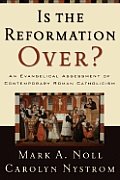
Is the reformation over? Mark Noll and Carolyn Nystrom

Thanks to Baker for sending me a review copy of the recent book by Mark A. Noll and Carolyn Nystrom: Is the Reformation Over? An Evangelical Assessment of Contemporary Roman Catholicism (Grand Rapids: Baker, 2005), 272 pp.

This is a fascinating historical and theological report on the developing ecumenical relationship between evangelicals and Roman Catholics in North America. Although the book doesn’t aim to provide a sustained theological analysis, it offers a wealth of valuable information about this important aspect of American church history, and it situates recent ecumenical developments within the broader contexts of North American social and political history.

The book’s theological analysis centres on Chapters 4 and 5. Chapter 4 reports on the various evangelical-Catholic dialogues that have taken place since the 1960s—dialogues which have fostered not only theological understanding, but also attitudes of personal respect and affection, thus helping to displace the polemical attitudes that have been so deeply ingrained in North American Protestantism (although, alas, “in the world of ordinary, unlearned evangelicals, atavistic anti-Catholicism remains as colourful ... as ever” [p. 187]).

In Chapter 5 the authors analyse the 1994 Catechism of the Catholic Church. They praise its devoutness, clarity and theological content, and they highlight remaining areas of contention between evangelical theology and the teaching of the Catechism. On the basis of the Catechism, they rightly conclude that “ecclesiology represents the crucial difference between evangelicals and Catholics”—and they point out that evangelicals will never understand Catholic teaching without first grasping the Catholic doctrine of the church (pp. 146-47).

At the end of the book, the authors illustrate evangelical-Catholic differences by comparing the major Christian traditions to different languages (pp. 245-49). “Like languages, the Christian traditions are handed down unselfconsciously from generation to generation as complete systems of belief and practice.” Since Vatican II, the Catholic and evangelical languages have moved much closer towards each other, but they still remain different languages, “different ways of approaching, internalising, articulating, and expressing the Christian faith.” These systematic differences are “both a problem and a gift”—a problem for communication and understanding, but a gift that opens our eyes to the God who transcends the limits and boundaries of our own particular church structures.

And anyway, ask the authors, will not differences in language continue also in heaven, albeit with mutual understanding? For the time being, though, let us be content to be “like ents and hobbits” (p. 251)—“not yet speaking the same language and certainly misunderstanding much that the other says, but nonetheless communicating quite well and actually learning from the apparent idiosyncrasies of the other tongue.”

Sunday, 11 June 2006

The ecumenical requirement

“But the most important requirement for [the ecumenical] venture is that both partners in the dialogue have God before them and not behind them. All movement must be towards God, the depth of whose wisdom and mystery appears always to increase.”

—Hans Urs von Balthasar, Who Is a Christian? (London: Burns & Oates, 1968), p. 39.

Thursday, 8 June 2006

Rome warns Canterbury against women bishops

Cardinal Walter Kasper, president of the Pontifical Council for Promoting Christian Unity, has warned the Church of England that a move to ordain women as bishops would destroy the possibility of full communion with the Catholic Church.

Kaspar makes several ominous remarks about the ecumenical effects of ordaining women as bishops. But his main argument is: “Where mutual recognition and communion between bishops does not exist or no longer exists, where one can therefore no longer concelebrate the Eucharist, then no church communion, at least no full church communion and thus no eucharistic communion, can exist.”

Walter Kasper is an admirable churchman and a very gifted theologian, and I can see where he’s coming from in all this. But let’s be frank: it’s a real shame when the question of women’s ordination is reduced merely to a matter of ecumenical politics.

Tuesday, 16 May 2006

A four-year-old's ecumenical theology

I have occasionally posted theological insights here from my three-year-old daughter (who is now four). On the weekend, she and I were watching a documentary about Pope John Paul II. Like most young Protestant children, she didn’t know what a “Pope” is. So I explained that, just as our pastor cares for the people in the church, and just as the bishop cares for the people in a whole area, so the Pope cares for all the people in the whole world; he is pastor to the world.

She was satisfied with this explanation, so we continued to watch the film. The film showed the great crowd of people who came to celebrate the election of John Paul II back in 1978. When my daughter asked me why they were celebrating, I said the people were thanking God for their new special Pastor.

And at this point she made her incisive theological comment: “But why are they celebrating both God and the special Pastor?” With this simple question of the “both/and,” she summed up in a nutshell the whole Protestant critique of Catholic theology!

Tuesday, 2 May 2006

Protestant critiques of scholasticism

“The situation is the same with Scholasticism as with the Roman Catholic church in general. Those who do not admire them, those who are not in danger of becoming scholastics themselves, simply have no inner right to pass judgment on them.”

—Karl Barth, The Theology of John Calvin (Grand Rapids: Eerdmans, 1995), p. 26.

Saturday, 25 March 2006

Scripture, tradition and gospel

In Crete in 1987, international Lutheran and Eastern Orthodox theologians produced a consensual statement on the question of “Scripture and Tradition.” It included the following:

“This 'gospel' of salvation is the content of the Holy Tradition, preserved, confessed and transmitted by the Scriptures, by the lives of the saints at all times, and by the conciliar tradition of the church.... Holy Scripture, since it is the work of the Spirit within the tradition, has as the criterion of its appropriate comprehension Jesus Christ himself in the life and teaching of the one church.”

—“Ecriture et Tradition,” Episkepsis 18 (1987), 381:17.

Sunday, 19 February 2006

Ecumenical colloquium in Durham

Last week an international colloquium of 140 senior church leaders and theologians from the Roman Catholic, Anglican, Orthodox and Methodist churches met for six days at Durham University.

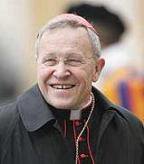
In the keynote address, the Roman Catholic Cardinal Walter Kaspar (pictured) stressed that “unity is symphonic”; unity in the New Testament is “unity in the diversity of charisms, offices, local churches, and cultures.” It is “communio sanctorum, that is, shared participation in the holy, in the life of God, in the Holy Spirit, in the Gospel, in the one baptism, and in the one eucharistic body of the Lord.”

On the first full day of the colloquium, N. T. Wright presided and Cardinal Kasper preached at an Anglican eucharist, and then Wright preached at a Roman Catholic eucharist the following day.

Catholic theologian Eamon Duffy described the colloquium as the most remarkable event in living memory. And N. T. Wright described it as theologically “jaw-dropping.” He remarked: “There are very serious voices within the Roman Catholic Church saying we are not three or four different Churches; we are all part of the one single Church which has some serious internal problems to be addressed. That’s a very different way of stating the ecumenical jigsaw than we have been used to.”

Other participants of the colloquium included Mario Conti, Terence Brain, Kevin Dunn, Michael Evans, Joseph Famerée, David F. Ford, Bernd Hilberath, Linda Hogan, Fergus Kerr, Nicholas Lash, Hervé Legrand, Andrew Louth, Paul McPartlan, Paul Murray, Brian Noble, Patrick O’Donoghue, Ladislas Örsy, James Puglisi, Thomas J. Reese, Stephen Sykes and Mary Tanner.

For further details of the colloquium, see the reports here and here.

Tuesday, 6 December 2005

Towards Eucharistic community

Back in 1998, the brilliant Lutheran theologian Eberhard Jüngel gave an address on Eucharistic community at the German Katholikentag. The address was translated this year and published as “Church Unity Is Already Happening: The Path Towards Eucharistic Community,” Dialog: A Journal of Theology 44:1 (2005), 30-37.

Jüngel models a theologically robust form of ecumenical dialogue in which confessional differences are not ignored or brushed aside, but are taken with full seriousness, and are analysed sharply so that a better understanding can be achieved.

In this address, Jüngel notes that the division between Catholic and Protestant communities “is and remains an ecclesiological scandal, to which the only legitimate scandal, the word of the cross, must put an end” (p. 36). Focusing on the Eucharist as an event of the gospel, Jüngel notes that in the Eucharist there is “no law which would demand human activities or human works,” but rather there is “simply the gospel itself, the gospel that presents to us the salvific action of the death of Jesus Christ” (p. 32).

Archive

Contact us

Although we're not always able to reply, please feel free to email the authors of this blog.

Faith and Theology © 2008. Template by Dicas Blogger.

TOPO