Showing posts with label evangelicalism. Show all posts

Monday, 22 August 2011

The challenge of John Stott

A guest-post by David Williamson

The death of John Stott (1921-2011) is a watershed moment in the history of evangelicalism. He represented a faith which was not neo-fundamentalism but a bold effort to engage and love a rapidly changing world. It was a renewal movement in Christianity and reformational in spirit; its major focus was sharing theology with men and women in the pews, in recognition that people with jobs and families were the real priests on the frontline. In contrast with the pietism of past generations, this infusion of knowledge was intended to spur an outpouring of love; not only was the traditional evangelical emphasis on the "great commission" of disciple-making celebrated, so was the "greatest commandment" of loving your neighbour.

This is not the popular image of evangelicalism. The assiduous courting of American evangelicals was a key part of Karl Rove's strategy to secure a sustainable future for the Republican party. The emergence of the religious right has undoubtedly been one of the major phenomena in modern western politics, but this has not been the driving concern of the movement itself. In fact, the apparent ease with which many evangelicals were co-opted at elections suggests evangelicals in America spent too little time thinking about politics and not too much.

The UK Guardian provided perhaps the best British obituary of Stott, which noted that his theological conservatism did not automatically translate into political conservatism. David Turner wrote:
Stott, radical in his conservatism, could not be pigeonholed. He was deeply committed to the need for social, economic and political justice and passionately concerned about climate change and ecological ethics. He regarded the Bible as his supreme authority and related its teaching to all areas of knowledge and experience. He insisted that Christians should engage in "double listening" – to the word of God, and to the world around them – and apply their biblical faith to all the pressing issues of contemporary culture. He himself researched, preached and wrote on a wide range of matters – from global debt to global warming, from the duties of the state to medical ethics and euthanasia. This was the kind of evangelicalism he embodied.
Similarly, Nicholas Kristof in the New York Times started his tribute saying: "In these polarized times, few words conjure as much distaste in liberal circles as 'evangelical Christian'." He continued:
Yet that casual dismissal is profoundly unfair of the movement as a whole. It reflects a kind of reverse intolerance, sometimes a reverse bigotry, directed at tens of millions of people who have actually become increasingly engaged in issues of global poverty and justice. This compassionate strain of evangelicalism was powerfully shaped by the Rev. John Stott, a gentle British scholar who had far more impact on Christianity than media stars like Mr. Robertson or Mr. Falwell. Mr. Stott, who died a few days ago at the age of 90, was named one of the globe’s 100 most influential people by Time, and in stature he was sometimes described as the equivalent of the pope among the world’s evangelicals. Mr. Stott didn’t preach fire and brimstone on a Christian television network. He was a humble scholar whose 50-odd books counseled Christians to emulate the life of Jesus – especially his concern for the poor and oppressed – and confront social ills like racial oppression and environmental pollution. “Good Samaritans will always be needed to succor those who are assaulted and robbed; yet it would be even better to rid the Jerusalem-Jericho road of brigands,” Mr. Stott wrote in his book The Cross of Christ.
Stott's hunger to engage with the greatest social issues of our day came from his engagement with the Bible. His simple belief that this book contained wonder brighter than the beauty revealed by the Hubble telescope burned at the heart of his preaching and writing, which was remarkably un-flash; he did not come across as a motivational speaker or a salesman for the faith. Rather, he was more like an archaeologist who would find a ruby in the dust and pass it to you to admire and study in the years to come. John Piper, a hugely influential exponent of Calvinism, wrote:
To this day I have zero interest in watching a preacher take his stand on top of the (closed) treasure chest of Bible sentences and eloquently talk about his life or his family or the news or history or culture or movies, or even general theological principles and themes, without opening the chest and showing me the specific jewels in these Bible sentences. John Stott turned the words of Bible sentences into windows onto glorious reality by explaining them in clear, compelling, complete, coherent, fresh, silly-free, English sentences... This is what I was starving for and didn’t even know it. Amazing! Someone is telling me what these sentences mean! Someone is making light shine on these words. It is shining so bright, I can’t sleep in this light! I am waking up from decades of dull dealing with God’s word. Thank you. Thank you. I could care less if you tell me any stories. I want to know what God means by these words!
Evangelicalism now lacks a Stott figure. It's a huge beast of a movement encompassing millions of new Chinese converts, South Korean missionaries, Latin American Pentecostals, baseball-loving Americans and Congolese immigrants to Dublin. In the United States, and to some extent Britain, the theological focus appears to be less on biblical discovery and engagement with the wider world and more on attempting to nail down precisely what evangelicals should believe. Many of the most prominent bloggers seem determined to equate Calvinism (with its focus on predestination) with evangelicalism. However, while the concept that God ordains evil as well as good and that Jesus did not so much die for the sins of the whole world as those of the "elect" whom he would summon to himself (and not by their own free will) may have been at the heart of New England Puritanism, it would shock millions of evangelicals.

It is ironic that Stott's landmark work on the significance of Jesus's death and resurrection is celebrated as one of the key texts of modern evangelicalism by many of those at the forefront of the spectacular resurgence in neo-Calvinism; but somehow there does not seem to be the same enthusiam for Stott's vision of Christians following Christ's call to act as "salt and light" in a world God loves by seeking societal transformation. Tim Challies, a leading neo-Calvinist who loves the Bible and clearly wants to follow it faithfully, wrote last year:
There is a time and a place for humanitarian work, no doubt. Christians can carry out great ministries serving the poor and the oppressed and in so doing can have remarkable opportunities to share the gospel. And yet still the history of Christianity shows that when Christians do this, the gospel quickly becomes secondary and the work itself becomes the gospel. I still see the Bible primarily emphasizing charity given to other believers; when I look at Acts and the epistles, this is what I see most – Christians helping other Christians as a sign of love and fraternity. Now of course there will be some who engage in humanitarian work outside the context of the local church, but it seems to me that the closer we come to making this a necessary part of the Christian mission, the more likely we are to see the gospel diminish.
No doubt Challies can think of many examples where this has taken place. And it is true that evangelical-founded relief organisations such as World Vision and Tear Fund face the challenge of operating as leading NGOs while finding a way to express an eternal Christian message. Also, at a time when evangelicalism is bereft of a unifying leader, it alarms many when evangelical scholars question and challenge doctrines traditionally considered core tenets of evangelical orthodoxy. In such a climate, theological and social retrenchment can appear attractive, even tempting.

But contrast this with Stott's own meditation on salt and light in a 2006 interview which today stands as a challenge to the movement he led with humility and passion throughout a splendid life:
They change the environments in which they are placed. Salt hinders bacterial decay. Light dispels darkness. This is not to resurrect the social gospel. We cannot perfect society. But we can improve it. My hope is that in the future, evangelical leaders will ensure that their social agenda includes such vital but controversial topics as halting climate change, eradicating poverty, abolishing armories of mass destruction, responding adequately to the AIDS pandemic, and asserting the human rights of women and children in all cultures. I hope our agenda does not remain too narrow.
This post first appeared at Van Peebles Land.

Wednesday, 23 February 2011

Theology FAIL: Chuck Colson's doctrinal boot camp

Evangelical leader (and former tough-as-nails US Marine) Chuck Colson wrote a Christianity Today piece on "Doctrinal Boot Camp", where he argues that catechesis for "younger evangelicals" should be modelled on the Marines. Apparently what the church really needs is more psychological brainwashing, self-abnegating conformity, and absolute unquestioning obedience. He relates a conversation with another former Marine:

I asked him about younger evangelicals who believe that we oldsters aren't being sensitive enough to their concerns. ‘Can you imagine,’ he asked, ‘what would happen if a scruffy young recruit were to tell his Marine drill instructor at Parris Island that he ought to be more sensitive to his needs?’ We both chuckled, knowing what would happens to the poor recruit. If he survived, he'd be doing 100 pushups a day for weeks.
Grrrr, we youngsters just hate it when former Marines chuckle together about our theological naivety! Anyways, David Congdon has issued a blistering response to this ecclesiastical legalism. He writes:
The commanding authority that Colson sees as the analogue of the drill sergeant is not Jesus or God, but rather the church. It is the authority of the church, not the authority of Christ, that demands our formal, blind obedience. Colson’s theology is the deification of the church, and thus the deification of a particular cultural form. Despite his best intentions, the gospel on such an account is simply propaganda.
Although David's argument is an excellent response, I'd also be intrigued to see a church where the minister really does address the congregation like this (maybe I'll try this in one of my theology classes too):


Now that I think of it, there is one minister who achieves a Marine-like theological severity – the fabulous Mitchell and Webb vicar. Maybe this guy was Chuck Colson's inspiration:

Sunday, 23 May 2010

Doubt

The other day, a woman told me the following story. One evening she gave an address to a church congregation. After the talk, a stern-faced member of the congregation came up and said, "You're a liberal, aren't you – but with none of the doubt." It's a nice way of putting it. If I'd been there, I suppose I would have been told that I'm an evangelical, but with all of the doubts.

Thursday, 17 September 2009

Divine flu: a health warning

by Kim Fabricius (originally printed in this month's Reform magazine)

This is an ecclesiastical health warning for “divine flu”. There are two potentially fatal forms of this malady afflicting the church. One is caused by the Tweedledum virus, the other by the Tweedledee virus.

Theo-chemically, the viruses are mirror images of one another, and can only thrive in symbiotic relationship. The technical terms for the related illnesses they cause are “neo-liberalism” and “conservative evangelicalism”. Here is a list of ten symptoms associated with each pathology. Sufferers may not exhibit all of these symptoms, but if you experience some of the symptoms you should immediately seek medical attention.

Neo-Liberalism

Sufferers

• Feel the omission Old Testament readings from Sunday worship is a welcome relief rather than an egregious truncation. They regard the preacher as a reflector on experiences, or a community life-coach, rather than one called to confront the congregation with God’s living word of grace and judgement.

• Tell us the Creeds are old-fashioned, bang on about “relevance” and, with “chronological snobbery” (C. S. Lewis) masking historical ignorance – the idea that the Church Fathers or Reformers believed in a bearded celestial pensioner is risible – instruct us about what modern people can and cannot accept.

• Give Trinity Sunday, the climax of the Christian year, a miss. Or if that is not possible, delight in the crypto-unitarian images – the three lobed-leaves of the shamrock, or the three states of water – of the children’s address, as if the doctrine of the Trinity were a mathematical puzzle rather than a description of God’s very identity.

• Deny the divinity of Christ (while acknowledging him as great guru, right up there with the Buddha), speak of the resurrection as a “spiritual” reality (i.e. as something that happened to the disciples, not to Jesus), and so cannot worship or pray to Jesus; and, consequently, don’t know what to do with Paul.

• Think “Calvin and Barth” is the name of a comic strip, that orthodoxy is dull rather than dangerous, and that John Spong is a “progressive” theologian rather than a recycler of Enlightenment ideas.

• Mistake counselling for the cure of souls, clinical psychology for spirituality, and prefer the nostrums of Myers-Briggs and James Fowler to the wisdom of the Desert Fathers.

• Argue that Jesus’ silence on the subject of homosexuality is germane to the contemporary debate about same-sex relationships, presumably not realising that an argument from silence is a non-argument, i.e. a fallacious argument.

• Believe near-death experiences are relevant to our understanding of what St. John calls “eternal life”.

• Seem reluctant about declaring that “Christ died for our sins”, and shy, even embarrassed, about saying that they are “born-again”, or that they “love the Lord Jesus”.

• Are fans rather than followers of Jesus when it comes to his absolute rejection of violence; for example, they will kill other people if the state tells them to.


Conservative Evangelicalism

Sufferers

• Read the Bible only in the original version – the NIV, of course! – as if there were a neutral and stable position from which this library of a book could be translated, as if translations weren’t themselves interpretations, and as if our interpretations of these interpretations didn’t go all the way down and resist closure – they do.

• Hold tenaciously to the quite unbiblical, relatively newfangled, and deeply problematical doctrine of biblical inerrancy.

• Act like the doctrine of penal substitution is in the Creeds, find nothing at all sub-Christian in the idea that God “punished” Jesus on the cross, and deploy this model of the atonement as the litmus test for distinguishing “real” Christians.

• Argue that the Levitical and Pauline condemnations of homosexuality conclusively settle the contemporary discussion of same-sex relationships, insisting, however, that “while we hate the sin, we love the sinner.” (Gay/Lesbian Christians: “Yeah, right!”)

• Worship with “choruses” that are four lines long, a half-inch deep, and take 20 minutes to sing.

• Punctuate their prayers with the word “just” (“Father, we just pray this, and Father, we just pray that”) with mind-numbing repetition, and assume that the more people you have praying about something, the more likely you are to get a result.

• Despise Richard Dawkins while actually believing in the kind of God he rightly rejects, as if the existence of God were, in principle, demonstrable, as if the proposition “God exists” were a hypothesis to be affirmed or denied, as if God were simply the hugest of individuals.

• Treat the visions in the book of Revelation as if they were the prognostications of a Nostradamus rather than imaginative murals of encouragement for confessing churches and protest against militant empires.

• Believe, sometimes with quite unpleasant schadenfreude, that hell will be full rather than empty – and that they have access to the Inferno’s census.

• Are fans rather than followers of Jesus when it comes to his absolute rejection of violence; for example, they will kill other people if the state tells them to.


I repeat: both forms of divine flu are very serious and potentially terminal. However, if forced to choose, this theo-clinician would say that neo-liberalism rather than conservative evangelicalism is the greater danger to the life of the church itself. Why? Because (to rephrase the American Presbyterian Hugh T. Kerr) it is easier to cool down the feverish than to warm up the undead.

Neo-liberals, the problem is not that you are too critical, but rather not critical enough; and conservative evangelicals, the problem is not that you are too biblical, but not biblical enough. Let the healing begin!

Sunday, 29 June 2008

The pornographer's dream: or, the problem with contemporary worship

There’s been a lot of speculation in recent years about why so many evangelicals are converting to Rome and to Eastern Orthodoxy. I wonder whether the highly experiential focus of contemporary worship might have something to do with it.

The New York singer-songwriter Suzanne Vega has an entertaining song entitled “Pornographer’s Dream” (from her 2007 album, Beauty and Crime). In the song, Vega asks what kind of woman a pornographer would dream about:

Would he still dream of the thigh? of the flesh upon high?
What he saw so much of?
Wouldn’t he dream of the thing that he never
Could quite get the touch of?

It’s out of his hands, over his head
Out of his reach, under this real life
Hidden in veils, covered in silk
He’s dreaming of what might be

Out of his hands, over his head
Out of his reach, under this real life
Hidden in veils,
He’s dreaming of mystery.


It’s a nice idea: the pornographer, from whom nothing is concealed, dreams only of concealment itself. Unlike the rest of us, his fantasies involve not naked flesh, but a body “hidden in veils, covered in silk.” For the pornographer, the only thing forbidden is mystery, so that his fantasises are of clothed women, veiled flesh.

As an analysis of pornography, I think this is completely correct. The real problem with pornography is not that it is too erotic, but that it is not erotic enough. In seeking to reveal everything, to fulfil every fantasy, it destroys the very possibility of fantasy and eroticism. And so the use of pornography ultimately results not in erotic ecstasy or euphoria, but in mere boredom.

Perhaps all this can serve as a parable for the contemporary preference for experiential worship styles. Where every church service becomes the opportunity for a life-changing experience of the divine presence; where every song and sermon and prayer is designed to produce immediate emotional impact; where the whole Christian life is transformed into the pursuit of a “naked” experience of the divine – here, the final outcome can only be a profound and paralysing boredom. And for those subjected to such boredom, the only remaining spiritual desire is for a mysterious God, a God not merely naked and exposed, but clothed in ritual, sacrament, tradition.

Why are so many evangelicals converting to Rome and Constantinople? Perhaps their infinitely deferred quest for a Deus nudus has finally resulted in an unbearable boredom. Perhaps they’re dreaming of a God who is not always promiscuously available to immediate experience, but is instead “hidden in veils, covered in silk” – a more modest, and therefore more sexy God.

For what it’s worth, my own opinion is that we should avoid the pitfalls both of a promiscuous experientialism and of any reaction towards ritualism for its own sake. Instead of trying by our own efforts either to strip God or to clothe him, we should look to the place where God has both veiled and unveiled himself for us: in the event of Jesus Christ.

Thursday, 22 May 2008

How to be confessional

Steve Holmes discusses the Peter Enns affair, and asks what it means to be confessional. “Glancing through the published material, my overwhelming sense is that the real problem is that WTS was not confessional enough, or at least not secure enough in its own confessional status.”

Tuesday, 20 May 2008

Bruce McCormack on Peter Enns and Westminster

The redoubtable Bruce McCormack has weighed in on the Peter Enns debacle, with an excellent guest-post over at Arthur Boulet’s blog. McCormack argues that the Westminster report against Enns does not reflect a Reformed christology, but instead a Lutheran or even Eastern Orthodox christology.

In passing, he also makes a very interesting observation about contemporary Protestant theology: “I live in an ecclesial world in which those who value Christian orthodoxy as a concept seem invariably to drift towards either Rome or Constantinople or some amalgamation of the two which is represented by no existing church. The last thing most of my friends want is a truly Protestant theology (whether Lutheran or Reformed)…”

Tuesday, 13 May 2008

Daniel Radosh: Rapture Ready! Adventures in the parallel universe of Christian pop culture

Daniel Radosh, Rapture Ready! Adventures in the Parallel Universe of Christian Pop Culture (New York: Scribner, 2008), 310 pp. (review copy courtesy of Scribner)

Now here’s a fun bit of weekend reading. Daniel Radosh, a liberal New York Jew (who blogs here), sets out to discover what Christian pop culture is all about. Americans spent more than $7 billion on Christian products in 2006. This is big business, and, as Radosh soon learns, there’s an entire parallel world out there, a vast alternative to mainstream pop culture, “like a mirror universe from a science fiction tale” (p. 2).

The book does not attempt a systematic analysis of evangelical pop culture. Instead, it unfolds as a series of quirky “adventures.” Radosh wanders across the landscape of American Christianity, describing numerous colourful characters and events along the way. Although he begins his journey with considerable cynicism, he remains an open and inquisitive adventurer.

Indeed, the book’s real charm lies in Radosh’s capacity for surprise – he frequently revises his view of Christian pop culture; he is easily impressed by the good in people (even when they’re a little crazy); and he’s quick to offer a generous interpretation wherever possible. The result, then, is a good-humoured and surprisingly sympathetic sketch of this strange parallel universe.

Of course, Radosh has no sympathy for some aspects of Christian pop culture. He has nothing good to say about the absurdly sincere born-again actor, Stephen Baldwin (he satirises Baldwin in a hilarious staged interview, one of the cruellest and funniest parts of the book). And when he visits a Christian wrestling match, he can finally only shake his head: “I decided that maybe some forms of pop culture really can’t be made authentically Christian” (p. 248). Let’s hope he’s right.

Similarly, Radosh has nothing but contempt for the phenomenally popular Left Behind series – a series of books whose theological inanity and ethical debasement are matched only by their abysmal literary quality. Commenting on the rampant religious violence of the novels (he quotes the final novel, where Jesus returns in glory: “Men and women soldiers and horses seemed to explode where they stood. It was as if the very words of the Lord had superheated their blood, causing it to burst through their veins and skin. Their innards and entrails gushed to the desert floor…”), Radosh offers the wry conclusion: “Gloria in excelsis Deo, motherfucker” (p. 78).

Radosh is also rightly critical of the dehumanising effects of the evangelical abstinence movement, with its gender essentialism (men are aggressive by nature, women submissive), its “virginity fetish,” and its depiction of women’s bodies “as objects to be managed by men: first by fathers then by husbands” (p. 253). Following in the wake of the abstinence movement comes the Christian sex advice movement, with its belated attempt to help evangelicals overcome their deeply ingrained sexual inhibitions. Although Radosh is sympathetic with the aims of this movement, he is discomfited by its simplistic biblicism. It might be amusing to hear a sex manual using the Song of Songs to provide a clinical explanation of the mysteries of oral sex and genital fondling. But Radosh wonders whether the Bible is really “a universal instruction manual” of this kind; whether something important is lost when the Bible is turned into a mere self-help manual for married couples. “Paradoxically, by trying to read the Bible as all-encompassing, pop Christianity actually diminishes it” (p. 275).

There is, then, a close relationship between the various Christian chastity/sex movements and the otherwise very different phenomenon of evangelical creationism. In one of his most unsettling adventures, Radosh encounters Ken Ham (who frightens him, and strikes him as a “borderline sociopathic” character), together with other leading creationists. In a visit to the Creation Museum, Radosh is confronted by the chilling portrayal of an entire alternative universe in which the history of the cosmos is constructed through a quasi-scientific reading of Genesis. Again, the Bible is diminished – and, frankly, rendered incoherent and ridiculous – through such an all-encompassing application to contemporary questions.

Although Radosh rightly critiques (and occasionally ridicules) these diverse aspects of Christian pop culture, his overall impressions remain hopeful and positive. In most of his adventures he is surprised by what he encounters. For instance, he is expecting the worst when he meets spiritual warfare novelist Frank Peretti, since Peretti’s novels rail venomously against liberals and leftists. But Peretti offers a surprising and touching confession. Discussing his novels from the 90s, he grows suddenly sad, and then admits: “I was very angry when I wrote that…. I lashed out a lot at people” (p. 116).

Again, Radosh is charmed by a prominent Christian supplier who talks with candid regret about the poor quality of much Christian merchandise – referring to some Christian paintings, for instance, the supplier remarks: “You had to love Jesus in order to hang this on your wall, because it was almost a sacrifice” (p. 102). And when Radosh explores the strange world of Christian comedy, he is led to wonder whether “our culture war could be eased just a bit if the public face of evangelicalism was a good-natured, tolerant, funny ordinary guy instead of James Dobson” (p. 233).

Above all, Radosh’s adventures are marked by a glowing portrait of Jay Bakker – a progressive New York pastor, and son of disgraced fundamentalist preacher Jimmy Bakker – who emerges as the book’s real hero. In Radosh’s eyes, Jay Bakker represents the future of American evangelicalism, and his growing friendship with Bakker seems largely responsible for his hopeful evaluation of the future of Christian culture.

Most of all, however, Radosh’s hopeful outlook arises from his confidence in consumerism itself. Concluding the book, he suggests that the problems in evangelical pop culture – its tendency towards intolerance, for example – will be resolved as Christian pop culture is more fully assimilated into the mainstream market. The weirdness and bigotry that characterises some aspects of evangelical culture will thus eventually be smoothed out – not so much through dialogue, discussion and reflection, but merely through the levelling operation of market forces. The result will be a more liberal and more tolerant Christian culture – in short, a more precise mirror of the values of mainstream culture.

By and large, this analysis is probably correct: in the setting of late capitalism, the creation of a vibrant and distinctive niche market goes hand in hand with the emergence of mass homogeneity. But I’m not so sure this is a comforting prospect. Instead, it ought to raise some disturbing questions about the nature of evangelical culture. It seems to me that the only flaw in Radosh’s analysis is his assumption that evangelical consumerism can be neatly distinguished from evangelical identity – as though the modification of evangelicalism’s consumer culture would not also be a modification of its religious identity.

The issues involved here are, to my mind, far more urgent than Radosh’s concerns about helping evangelicals to become nicer and more tolerant. We should perhaps ask what it means for religious believers to identify themselves by the merchandise they consume; what it means when we allow ourselves to become not a community, but a sub-culture, and thus one more market niche alongside others.

As Slavoj Žižek has observed, the logic of late capitalism presses towards the commodification of a niche identity for its own sake; the Christian merchandise I buy is not itself the desired commodity, but it is merely an ephemeral signifier of the real commodity, which is my identity as a particular sort of Christian. In this case, the product I am really purchasing is radically non-material, wholly spiritual; I am purchasing religious meaning and belonging, religious “community” (since the merchandise allows me to participate in a specific market niche). Here, any neat separation between my “faith” and my “consumer culture” is simply fictitious. To change the latter simply is to change the former.

So what we need today, I believe, is a sustained theological critique of this commodification of Christian identity, and a recognition that the spiritual identity provided by a consumer sub-culture is a seductive simulacrum, an obstacle to the risky venture of Christian faith. If we are to find authentic Christian identity, it will arise not from the benevolent operations of the market, but in a community which creates a new economic space within the world, with its own practices and its own ways of belonging. (More on this to follow soon in my review of William Cavanaugh’s excellent new book, Being Consumed: Economics and Christian Desire.)

In conclusion, I think Daniel Radosh provides valuable insight into the workings of American evangelical pop culture. The book is a real page-turner, littered with surprising discoveries, zany characters, humorous observations and wise insights (it also has an excellent companion website). In the end, though, I just can’t share Radosh’s optimism about the future of Christian pop culture. Instead, my hope would be for the demise of this pop culture, and for the appearance instead of a church that knows its own identity – not an identity that can be bought and secured, but one that comes freely and without guarantees, only because it is sheer gift.

Wednesday, 7 May 2008

An evangelical manifesto

Michael points us to a fascinating new document, The Evangelical Manifesto. I’ve only read the summary, but it looks as though the manifesto is specifically trying to rescue evangelicalism from the politics of the Religious Right. Signatories include Miroslav Volf, Kevin Vanhoozer, Darrell Bock, Justo Gonzalez, Mark Noll, Alvin Plantinga and Amos Yong.

Tuesday, 29 April 2008

The theological basis of Peter Enns' suspension

Westminster Theological Seminary has now released the official documentation relating to the recent suspension of Peter Enns. Included are the theological and hermeneutical Reports, prepared by Enns’ colleagues, which outline the objections to his book on Inspiration and Incarnation. It makes for unpleasant reading.

The “Historical and Theological Field Committee Report” is especially depressing. The Report makes it clear that Enns’ heterodoxy was already a settled issue for these colleagues; there is no real engagement with his book, no reflection on the theological questions, and certainly not even a glimmer of self-critical humility. Every question is settled in advance; the authors are invincibly persuaded of their own rightness.

The explicit purpose of Enns’ book was to generate discussion about the doctrine of scripture in light of current historical research on the biblical texts and their contexts. He was specifically trying to generate new discussion and new reflection among conservative evangelicals. But his colleagues at Westminster – somehow still entrenched in the old modernist controversies of a century ago – react with a defensiveness that is painful to witness.

They counter Enns’ whole approach by asserting that “Scripture’s author is God, who uses ‘actuaries’ or ‘tabularies’ to write His words,” so that “what men write down is as much God’s own words as if He had written it down without human mediation.” (Am I dreaming? Did a committee of theologians really produce that statement?) You can see why Enns felt it was necessary to write a book like this. You can see why a bit of fresh doctrinal reflection might be in order. But these colleagues will have none of it: they simply retreat back to the safety of another century, insisting that “there is no mention of the human authors of Scripture” in the Westminster Confession (their emphasis). Or they remark that “it is difficult to see” how Enns’ approach “can be made compatible” with the position of B. B. Warfield. No reflection on what Enns is saying. No engagement with his proposal. Not even a pretence at actually listening to him. Just a series of assertions about the self-evidently unacceptable nature of Enns’ book.

But the Report only gets worse. It’s sadly revealing to see the way objections against Enns are simply piled up, willy-nilly, without any modesty or sense of proportion. On a number of occasions, the authors complain that Enns’ book is “unclear.” For example, they complain that his description of scripture as “ultimately from God” and “God’s gift to the church” is “fuzzy at best in that it can accrue to an almost infinite number of things. In that sense, it is not an affirmation of the church’s historic understanding of inspiration.” Fuzzy? Theologians can now be suspended for fuzziness? In any case, the sheer irrelevance of such complaints is precisely the point: when you’ve already made up your mind in advance, any old criticism will do.

In the same way, a large proportion of this theological report is devoted to establishing Enns’ guilt by association. His views smack of “a neo-orthodox construal of revelation.” He “seems to display basic affinity with a Barthian view of Scripture.” There “seems to us to be a connection between the Post-Conservative Evangelical method [i.e. of Grenz and Franke] and the doctrine of Scripture set forth in Inspiration and Incarnation.” None of this is theological argument. None of it demonstrates why Enns’ approach is wrong. None of it has any relevance for the doctrinal question which the Committee is ostensibly addressing. On the contrary, the Committee simply relies on the invocation of cheap slogans – “post-conservative!” “neo-orthodox!” – in order to produce guilt by association.

Unfortunately, that’s the flavour of this “Theological Field Committee Report.” It would be irritating if such a report had been written by mindless bureaucrats who don’t know any better. But the fact that it was written by professional theologians – by Peter Enns’ own colleagues – is simply depressing.

Wednesday, 7 November 2007

Žižek and evangelicals

David Fitch is writing a book which analyses American evangelicals using Žižek’s concepts of “symptom” and “surplus.”

Saturday, 22 September 2007

An interview with Kevin Vanhoozer

Interviewer extraordinaire and all-around-nice-guy Guy Davies has posted an excellent interview with America’s best conservative evangelical theologian, Kevin Vanhoozer.

It’s good to hear that Vanhoozer is currently working on a new book for the Cambridge Studies in Christian Doctrine series, entitled Remythologizing Theology: Divine Action, Passion, and Authorship. In this book, he’s arguing that the God-world relation takes the form not of causality but of communicative speech. Vanhoozer has already sketched this idea in First Theology – and I’ve often thought that this is the best of all his constructive proposals to date. (I wonder if Vanhoozer has ever come across Gerhard Ebeling’s little 1967 book, God and Word, which makes a very similar proposal, albeit from a Bultmannian direction.)

As Guy’s interview reveals, Vanhoozer is also planning a full systematic theology: “Everything else is but a tilling of the ground…”

Thursday, 31 May 2007

Encounters with tradition (2): from evangelical to post-evangelical

A guest-post by D. W. Congdon

There are certainly problems with calling “evangelicalism” a tradition. To some, it refers simply to the Protestant churches born out of the Reformation. To others, it refers to the pietistic, Anabaptist traditions. To others, more recently, it refers to the American Free Church movement, which is more a sociopolitical reality than anything else. And to others still, it refers to a kind of Christian fundamentalism. I wish to affirm all of these uses of the term, and all of them apply to my own journey as an evangelical Christian.

I grew up in your textbook American evangelical home: strong nuclear family, large extended family (presently over 50 first cousins), rooted in Scripture (devotions every night; Bible memory verses at every dinner), committed to biblical inerrancy and a male-female complementarianism (i.e., hierarchicalism), avid believers in six-day creationism, distrustful of anything related to the secular academy, loyal Republicans, Baptist heritage, descendants of Jonathan Blanchard (founder of Wheaton College), homeschooled, raised with strong moral principles, and active in our local nondenominational church at every level of ministry. And this description only scratches the surface.

In writing this post, therefore, I do not come with any experience in moving from one established Christian tradition to another. I grew up and remain an American evangelical of sorts. But within the course of my lifetime, evangelicalism became a much more fluid, malleable, and diverse entity. Within a single decade, I saw the rise of evangelical feminism, evangelical leftist politics, evangelical engagement with evolution (beyond creationism and ID), and most importantly, an evangelical engagement with ancient and contemporary theology in ways that had not been the case before. Of course, we might also mention the rise of the emerging church movement within American evangelicalism. Regardless of whether one sees this as a positive or negative development, it is at the very least indicative of how evangelicalism has expanded over recent years.

In my years as a student at Wheaton College, I went through a seismic shift in thinking. I arrived with no awareness of the diversity within the Christian church (which I honestly thought was limited only to Free Church evangelicals) and no understanding of the complex debates over the Bible, theology, politics, and other issues which I had simply taken for granted. All of that changed for me within the course of a year. As an English major, I did a lot of reading, and the three books that affected me the most during my first year were Augustine’s Confessions, Dante’s Divine Comedy, and G. K. Chesterton’s Orthodoxy – all by Roman Catholics. Finally, in the summer before my second year, I read Mark Noll’s Scandal of the Evangelical Mind, and this turned the tide for good.

I experienced a rather violent “conversion” process, and it took me a full two years to work through some of the major issues. Besides physically throwing Noll’s book after finishing it the first time, I went through a polemical stage in which I set about rejecting my heritage. Numerous angry emails later, I began to emerge from my youthful ire into a more mature readiness to construct a positive position which upheld the important elements of my upbringing (e.g., fidelity to Scripture, involvement in the church, concentration on the cross of Christ) while incorporating the insights that I had gained from others, such as Karl Barth. One insight in particular came from the experience of attending an Anglican church during my last year at Wheaton. The discovery of the liturgy and the eucharist for the first time (!) radically changed me in ways that simply reading theology never will.

In the end, I still consider myself an evangelical, but I am a much different person than I used to be – hopefully for the better. I am not entirely sure “post-evangelical” is the best term to describe where I am today, because I have no intention of being anything other than steadfastly evangelical (though I define this term in a much broader way now). Even so, it seems to be the term most used to describe this new orientation within evangelicalism. If by “post-evangelical” we mean a commitment to Scripture, the Protestant solae, and the local church combined with a moderate-leftist politics, then this is indeed the “tradition” in which I locate myself today.

Friday, 25 May 2007

Scot McKnight and Mariology

Over at Internet Monk, there’s an interview with Scot McKnight about the new evangelical interest in Mariology. If you’re not yet familiar with Scot’s excellent blog, you might also like to check it out.

Tuesday, 15 May 2007

Some discouraging statistics

“The impact of this book [Wayne Grudem’s Systematic Theology] on evangelicals should not be underestimated. Over 135,000 copies have been sold, and the abridged version, Bible Doctrine, … has sold over 35,000 copies. The former is now the most widely used systematic theology text in evangelical seminaries and Bible colleges in North America and most other English-speaking countries.”

—Kevin Giles, Jesus and the Father: Modern Evangelicals Reinvent the Doctrine of the Trinity (Grand Rapids: Zondervan, 2006), p. 20.

Monday, 7 May 2007

ETS president converts to Rome

Aaron notes that, in a fascinating turn of events, the current president of the conservative Evangelical Theological Society (ETS) has converted to the Roman Catholic Church. Francis Beckwith had planned to keep his conversion under wraps until the end of his term as ETS president. But unfortunately a talkative blogger broke the news. So now, in an attempt to minimise controversy, Beckwith has decided both to resign as president and to withdraw his membership from the ETS. (Ironically, however, he observes that “I can in good conscience, as a Catholic, affirm the ETS doctrinal statement.”)


On his blog, Beckwith discusses his conversion to Rome, as well as his resignation from the ETS. It’s depressing to see the rancour of some of the Protestant responses. Even a professional theologian (who ought to know better) adds a comment describing Beckwith’s conversion as “a sad day for all true sons and daughters of the Protestant Reformation, for all who lived and died for its truths” – as though the religious violence of the 16th and 17th centuries (“living and dying”) were the proper norm for a contemporary understanding of ecclesial differences – or as though our primary responsibility today were to honour the dark legacy of this violence!

Thursday, 12 April 2007

Political side-effects?

Over at the Boar’s Head Tavern, an extended discussion developed in response to Kim’s recent propositions on political theology. The discussion is summarised, with all the related links, at Confessing Evangelical.

There were lots of other detailed discussions of this post as well, including one at Imaginations in Unity, another at Ponderings on a Faith Journey, another (in French) at TheoHead, and another at Spaceman Spiff.

In the last few days, there have also been some very interesting engagements with Kim’s propositions on freedom: see the discussion at Pseudo-Polymath, and the critical response at Positive Liberty.

Monday, 5 February 2007

Karl Barth and American evangelicals: friends or foes?

The Center for Barth Studies at Princeton Theological Seminary announces its second annual conference on Karl Barth, co-sponsored by the Karl Barth Society of North America: Karl Barth and American Evangelicals: Friends or Foes? The conference will take place in Princeton, 24-27 June 2007.

Speakers include D. G. Hart, Michael Horton, George Hunsinger, John Hare, Clifford Anderson, John Franke, Bruce McCormack, and several others. Last year’s conference sold out, so early registration is recommended.

Tuesday, 14 November 2006

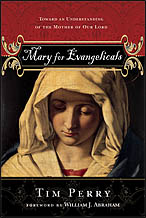
Tim Perry: Mary for Evangelicals

Tim Perry, Mary for Evangelicals: Toward an Understanding of the Mother of Our Lord (Downers Grove: IVP, 2006), 320 pp. (with thanks to IVP for a review copy)

Since Vatican II, we have seen remarkable developments in ecumenical understanding between Roman Catholics and Protestant evangelicals. But Mariology has remained a point of special contention. The progress in ecumenical understanding was most evident in the CCET’s 2002 conference on “Mary: Mother of God” – and in recent years, American writers like Donald Bloesch, Timothy George and Robert Jenson have made significant steps towards the development of a Protestant Mariology. But until now we have not witnessed a full-scale Mariology written from an evangelical perspective.

In this bold and ambitious new book (released last week), Tim Perry seeks to fill this gap, and to provide a biblical, historical and dogmatic account of the place of Mary in the faith of the church.

Perry begins with a careful exegetical analysis of the diverse portrayals of Mary in the New Testament. For Paul, Mary is merely as an anonymous mother, while Mark portrays her negatively as a misguided opponent to Jesus’ ministry and Matthew focuses on the scandal of Mary’s pregnancy. Only in Luke/Acts does Mary begin to emerge as “a major character” (p. 63) with her own theological significance. Perry admits that it is impossible to reconstruct a “historical Mary” based on the material in Luke/Acts; Luke’s infancy narrative is “theological history,” and as a result our interpretation must be concerned not with “the history behind the text” but only with “the text itself” (p. 66). It is especially by “relocat[ing] the locus of God’s salvation from the death and resurrection of Jesus to his miraculous conception and birth” that Luke is led to confer “a new, higher status” on Mary (p. 94).

If the Lucan Mary bears some traces of symbolic representation, it is in the Johannine literature that Mary becomes virtually submerged in theological symbolism. Paradoxically, on the one hand the Johannine literature treats Mary as “a highly developed literary device” (p. 113), but on the other hand Mary’s individuality almost entirely recedes from view. (For instance, the Fourth Gospel refers to Mary simply as “the mother of Jesus” or even “woman”!) Thus Perry observes that the Johannine Mary is, in some ways, really not far from Paul’s depiction of an anonymous mother (p. 113).

Perry therefore concludes that there are two main ways of depicting Mary in the New Testament: there is “Mary the person” and “Mary the symbol.” And in his finely drawn survey of the historical development of Mariology in the West (pp. 119-263), Perry highlights the ways in which the symbolic Mary “has come almost completely to suffocate” the individuality of Mary the person. If we are to develop a biblically responsible Mariology, then, we must give far greater emphasis to “Mary the person,” to the one “who hovers on the margins of her society and on the fringes of the biblical text” (p. 263).

Turning at last to a constructive dogmatic Mariology, Perry argues that Mariology finds its “theological anchor” in the confession of Theotokos, Mother of God (p. 267). The Theotokos makes it clear that Mariology “naturally arises out of Christology – what the church confesses about Mary stems from and is intended to clarify what it believes about Christ” (p. 269). And, for Perry, the importance of the Theotokos can hardly be overstated: “if Mary did not bear God in her womb – if she is not Theotokos – human beings are not saved” (p. 271).

Next, Perry follows Karl Barth in emphasising the sign-character of Mary’s virginity. Her virginity is not primarily a matter of sexual abstinence, but it is the positive determination of her being as “wholehearted fidelity to the prophetic calling of bearing the Word of God” (p. 284).

Further, Perry focuses on divine predestination as the determination of Mary’s place in God’s plan. Drawing closely on Robert Jenson’s account of election and pre-existence, Perry argues that just as the Son’s pre-existence is not an atemporal preincarnate existence but rather a (supralapsarian) movement towards incarnation, so too Mary herself must be regarded as eternally elected to be Theotokos: “If the man Jesus Christ is elect from all eternity to be the humanity of God, then the woman Mary is elect from all eternity to be the mother of that man who is God” (p. 288). Moreover, Mary’s holiness should be understood not in legendary or quasi-biological terms, but simply as “the faithfulness with which she embraced and pursued the divine commission to be the slave of the Lord” (p. 293). Mary’s sanctity, then, consists precisely in her “paradigmatic human response to the grace of God disclosed in Christ” – and not in any legendary notions of a miraculous beginning or end to her life (p. 295).

Finally, on the basis of Mary’s role as Theotokos, Perry argues that we can give a proper place to her role as intercessor, mediator and advocate – although he suggests that, from his own Reformed perspective, Mary’s role as coredemptrix can be affirmed “only in the weakest possible sense,” since from this perspective Mary cannot be regarded as cooperating synergistically with grace (p. 306).

The underlying argument of this whole dogmatic account of Mariology is that some of the central loci of Christian theology will be incomplete and unbalanced unless they also integrate Mariological reflection. Christology requires an emphasis on Mary as Theotokos; the doctrine of God requires an emphasis on Mary’s place in divine election; and ecclesiology requires an emphasis on Mary’s ongoing role in the faith and life of the church. In short, “to pass over Mariology … inevitably leaves other central Christian doctrines underdeveloped” (p. 268).

With its sophisticated historical and exegetical grounding, its careful subjection of church tradition to the witness of Scripture, and its ambitious attempt to integrate Mariology into the whole structure of Protestant dogmatics, this book offers an important and challenging contribution to the contemporary ecumenical conversation.

Tuesday, 17 October 2006

Kevin Vanhoozer: first theology

Kevin Vanhoozer is one of the finest theologians working today in the tradition of North American evangelicalism – and as a theorist of theological hermeneutics he has few peers. Some of his central insights are articulated in this collection of essays: First Theology: God, Scripture and Hermeneutics (Downers Grove: IVP, 2002), 384 pp. – and I’m grateful to IVP for a review copy.

For Vanhoozer, the term “first theology” describes the complex problematic of God, Scripture and hermeneutics. The proper locus for thinking God and Scripture together is hermeneutics; from this perspective, he says, “the questions of God, Scripture and hermeneutics [are] one problem” (p. 9). In exploring hermeneutics, Vanhoozer is not trying to develop an isolated, pre-theological prolegomenon. On the contrary, he wants to do “theology beyond prolegomena” by pursuing “a way of speaking of God that allows the theological matter to influence the theological method” (p. 16).

One of Vanhoozer’s central claims is that “[o]ur view of Scripture affects our view of God, just as our view of God colors our view of Scripture” (p. 30). This means that we cannot discuss God apart from Scripture, nor can we discuss Scripture apart from a trinitarian doctrine of God.

Vanhoozer conceptualises this God-Scripture relationship by describing “God as a triune communicative agent and Scripture as the written locus of God’s communicative action” (p. 38). Theology itself, then, is simply “God-centered biblical interpretation,” and as such the aim of theology is to develop a biblical imagination, so that we see reality as Scripture sees it (pp. 37-38). Indeed, faith itself means “having your thinking, imagining, language and life shaped by the biblical texts” in all their diverse literary genres (p. 334). Although there is much that is of value here, one wishes that Vanhoozer would attend not only to the literary genres of the Bible but also to the Bible’s historicity – and in this way he might overcome his fundamental distrust of the historical-critical method. (Most professional biblical scholars would be surprised to learn [p. 18] that “the critical approach promises knowledge but does not deliver”!)

Some of the book’s most impressive essays are concerned with specific hermeneutical reflections on the doctrine of God. Above all, Vanhoozer emphasises the communicative character of God’s being. Perhaps his most profound and most significant proposal is the thesis that “God’s presence is neither spatial nor substantive but communicative”; it is “the presence of personal address and response” (p. 90). Here, he suggests that such a communicative conception can overcome the impasse between classical theism and panentheism. Thus he depicts the God-world relationship as one of “communicative rather than causal agency” (p. 117). “God comes to the world in, and as, Word” (p. 123) – God is with his people not substantially, spatially or causally, but “through speech acts” (p. 149).

In dialogue with the tradition of Barth, Vanhoozer seeks to overcome the personal/propositional dichotomy that has long characterised discussion of the doctrine of Scripture. He argues that “[t]he neo-orthodox emphasis on the self-revelation of God is faulty only in its neglect of the semantic means by which this disclosure takes place” (p. 157) – a point that has also been raised by leading British theologians like Colin Gunton and John Webster.

In his depiction of Scripture, Vanhoozer thus utilises speech-act theory to fuse the central emphases of “neo-orthodoxy” and conservative evangelicalism: “the Bible is the Word of God (in the sense of its illocutionary acts) and … the Bible becomes the Word of God (in the sense of achieving its perlocutionary functions)” (p. 195). Just here, the fusion of the doctrine of God with the doctrine of Scripture is clear, since the Bible is precisely the locus of what God does by speaking and of what happens as a result of God’s speech.

Such a view of Scripture is, of course, a long way from “the postmodern despair of language.” In contrast to such hermeneutical “despair,” Vanhoozer advocates a Christian “delight in language” based on the realisation that language is itself the gift of God (p. 33). Further, he suggests that textual interpretation depends on the virtues of faith, hope and love: faith that there is “a voice, a meaning in the text”; hope that the interpretive community can attain understanding; and love as “a mutual relation of self-giving between text and reader” (p. 231). These hermeneutical virtues are not our own achievement, but they are the work of the Spirit – so that the prayer of the theologian is: “Veni spiritus interpres! Come interpreter Spirit!” (p. 235).

Vanhoozer’s attempt to bring together the doctrines of God and Scripture by way of a renewed theological hermeneutic demands close attention. For those who feel daunted by the size of Vanhoozer’s major volumes – Is There a Meaning in This Text? and The Drama of Doctrine – this book’s account of hermeneutical theology will serve as a welcome introduction to the work of one of the most creative evangelical theologians working today.

Archive

Contact us

Although we're not always able to reply, please feel free to email the authors of this blog.

Faith and Theology © 2008. Template by Dicas Blogger.

TOPO