Following David’s post on annoying theological words, here’s my nomination for the Most Annoying Word (MAW) in contemporary theology:
Trinitarian \ˌtri-nə-'ter-ē-ən\
adj. Relating to a devout but vague fondness for the importance of the number three; the need to incorporate all theological statements within a balanced and inclusive schema; the formal bureaucratic procedure of ensuring that the Spirit does not feel marginalised or excluded. Examples: the real problem with his work is that it is not adequately trinitarian; the book’s focus on christology should be supplemented by a broader trinitarian description of the economy of salvation; Barth’s theology is not fully trinitarian, since it remains hampered by an underdeveloped pneumatology.
Now I like the Trinity as much as the next person, and I happen to think the Nicene Creed is the best thing ever written. But I think the use of the word “trinitarian” in much contemporary theology – as a generic slogan, applied willy-nilly on any occasion – has become an obstacle to real theological
thinking.
It’s interesting to note that the English term “Trinitarian” was first used, in the 16th and 17th centuries, as a pejorative description of anti-trinitarians; the
heretics were dubbed “Trinitarians”! Then, by the early 18th century, anti-trinitarianism had become so pervasive that
orthodox writers were now described as “Trinitarians.” The word’s checkered history already reveals its proper functions and limitations: it has some usefulness as a party slogan, but it’s not so useful as an instrument of serious thought.
Although the late Colin Gunton played a tremendous role in the revival of systematic theology, I suspect his own ubiquitous deployment of the term “trinitarian” has had
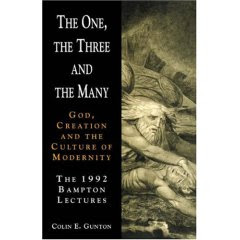
some unfortunate side-effects in contemporary theology. Worst of all, Gunton was also responsible for coining the unsightly and unseemly adverb “trinitarianly,” which has subsequently made inroads into theological discourse. (Admittedly, there were a few earlier uses of this adverb, but these were mercifully forgotten – the earliest I’ve found is by the American Presbyterian theologian W. G. T. Shedd, who used the word in 1863 to disparage Roman Catholic dogma: the Catholic Church, he growled, is “trinitarianly orthodox” even though it “remorselessly mutilates” and “annihilates” the doctrine of atonement.) As a result of Colin Gunton’s work, the word “trinitarianly” has now (like the word “trinitarian” before it) passed over into a
positive slogan rather than a
pejorative one.
Throughout his works, Gunton speaks – and these are just a few adverbial examples – of “a God conceived trinitarianly,” of “creation trinitarianly conceived,” of “revelation trinitarianly conceived,” of “trinitarianly conceived agency,” of “glory conceived trinitarianly,” of “immutability trinitarianly construed,” and (it gets worse) of the tendency to define God’s essence “pre- and extra-trinitarianly.” Unfortunately, more than a few theologians have
now started using the word in the same way, in spite of its ungainliness, its un-Englishness, and its tendency towards triviality.
Now I don’t mean any disrespect to the memory of Colin Gunton; and I certainly wouldn’t want to be accused of thinking “untrinitarianly.” But here’s my proposal:
let’s have a five-year ban on the word “trinitarian.” Perhaps if we avoided using the word so easily and so cheaply, we could concentrate more on
thinking the Trinity, and on finding fresh, arresting, non-sloganeering language to describe the reality of God.
Oh, and here’s my second proposal: the next time you hear the word “trinitarianly,” you should reach for your revolver. Or if you’re lucky enough to be
someone who edits theology manuscripts, you could just reach for your red pen instead.