“Like a bullet we’ll shoot for the carnival route
We’re following them dusty old fairgrounds a-calling”
—Bob Dylan, “Dusty Old Fairgrounds” (1973)
Welcome to the Sixth Biblical Studies Carnival, brought to you from the dusty old fairgrounds of Brisbane, Australia. This Carnival offers a glimpse of recent posts relating to biblical studies from around the blogosphere. Biblical studies has a large and active presence on the net, so I can only give you a tiny sample here. If you want to read more, make sure you check out the list of biblical studies blogs at the Biblioblogs site.
Highlight: An Unpapal Conclave
 The highlight of recent biblical studies blogging is Loren Rossen’s unpapal conclave on the historical Jesus. Loren takes up John Meier’s suggestion in A Marginal Jew that an “unpapal conclave” should be locked away “until [it] had hammered out a consensus document on who Jesus was and what he intended in his own time and place.”
Loren assembles such a (virtual) conclave to find out if there is any consensus on the question: “Who was the historical Jesus?” The conclave consists of atheists, Jews, agnostics, Protestants, Catholics, a Unitarian, and an evangelical. Unsurprisingly, there was not much consensus! Or, as Stephen Carlson put it, the experiment showed that “it is easier to get agreement about what Jesus said and did than what he meant by those words and deeds.” The experiment was critiqued by Mark Goodacre, and was discussed by Michael Pahl, James Crossley and Lingamish. Chris Weimer also set up a forum to discuss the experiment.
Loren’s experiment—whatever it be might be taken to mean about the historical Jesus!—is a brilliant example of the way contemporary scholarship can creatively utilise the possibilities of cyberspace. To get the full story, you’ll need to read Loren’s whole series of posts here, here, here and here.
Translation
Some of the most enjoyable posts this month have been in the area of translation. Henry Neufeld provides a nice new translation of Psalm 46, and in a series of posts at Biblicalia (here, here, here and here), Kevin Edgecomb offers his own translation of 1 Clement, a translation that aims to capture the rhetorical flavour of the Greek text. Complementing this, Rick Brannan translates 2 Clement 1; and as part of his ongoing series on the Didache, Rick also provides a translation with notes on Didache 3:7-10.
Hebrew Bible
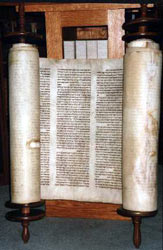 In the field of the Hebrew Bible, Ken Ristau analyses biblical and cuneiform law by assessing two recent articles on the topic. The Daily Hebrew blog has been working through the Hebrew text of Genesis 18-19 with detailed grammatical notes; and in two posts (here and here), Claude Mariottini explores Daniel 9:25-27. Meanwhile, Joe Cathey offers a poll about the centre of Old Testament theology, which prompts Kevin Wilson, Christopher Heard and Jim West to discuss the question of a “centre.” And Jim Davila presents a very nice photo essay on a seminal early-18th-century edition of Old Testament pseudepigrapha.
New Testament
 In the field of New Testament studies, Mike Bird discusses the case for and against a rhetorical approach to Paul’s letters, and Sean du Toit raises hermeneutical questions about the interpretation of the New Testament household codes in relation to the contemporary question of women's role in the church. Chris Petersen offers two posts (here and here) on E. P. Sanders' view of Paul, the Law and the Jewish people, and Danny Zacharias discusses questions of chronology in the last supper traditions. Scot McKnight tries to set the record straight about the meaning of “the wrath of God” in Romans 1, while Richard Anderson discusses the concept of covenant in Luke-Acts.
Meanwhile, Richard Bauckham has been in the limelight, with Celucien Joseph discussing Bauckham’s view of New Testament christology while Jonathan Brown reviews God Crucified, and Chris Tilling announces that he will be interviewing Bauckham about his (no doubt controversial) new book, Jesus and the Eyewitnesses.
Methodology
On more general methodological topics, Andreas Köstenberger discusses the future of evangelical scholarship on the New Testament, AKMA discusses biblical hermeneutics, and Jim West suggests some rules of engagement for debate in biblical studies. And in a series of seven posts, Michael Barber explores philosophical and methodological issues in historical Jesus research.
Da Vinci Code
 Meanwhile, there has been a continuing storm of activity as biblical scholars engage in debunking the eminently debunkable Da Vinci Code. Notably, at the Slate website, Larry Hurtado enters the fray with a discussion of the historical claims of The Da Vinci Code, while Ben Witherington discusses Dan Brown's own personal experience of Christianity. Lesa Bellevie continues to post regularly about Mary Magdalene, while, from a Catholic perspective, Michael Barber points out ten clear errors in The Da Vinci Code.
Software
Finally, it seems May was a big month for Bible Software. Rick Brannan discusses the release of Logos Bible Software 3, while Danny Zacharias mentions the release of Accordance 7. And on a related note, D. Christopher Spinks suggests that the traits of Web 2.0 might translate into traits of theological interpretation.
And the Carnival Rolls On...
Well, thanks for joining us here for the Sixth Biblical Studies Carnival. The Carnival rolls on, and next month it will be hosted by Joe Cathey, so keep an eye out for his call for submissions.
“Everything being a constant carnival, there is no carnival left.”
—Victor Hugo