
2005 highlights
Here are some of my personal highlights from the past year:
Travel highlight: visiting Calvin’s Geneva in July
Dining highlight: eating a perfect wood-fired pizza in a cosy little Italian restaurant in northern France
Movie: the Aussie film Look Both Ways
Documentary: the Martin Scorsese film about Bob Dylan, No Direction Home
Music: the release of Bob Dylan’s Live at the Gaslight 1962
Fiction: reading Susanna Clarke’s fantasy novel, Jonathan Strange and Mr Norrell
Poetry: reading Kevin Hart’s Flame Tree: Selected Poems
Theology: reading the new translations of Eberhard Busch’s The Great Passion: An Introduction to Karl Barth’s Theology and Wolf Krötke’s Sin and Nothingness in the Theology of Karl Barth.
New Testament: reading the special issue on the resurrection in the Journal for the Study of the Historical Jesus
Old Testament: reading John Goldingay’s Old Testament Theology, Vol. 1
Autobiographies: reading Bob Dylan’s Chronicles and Hans Küng’s My Struggle for Freedom
Thanks to all of you who have been reading this blog throughout 2005. I wish you a very happy New Year.
 On 1 December, Benedict XVI addressed the International Theological Commission. He had some very profound things to say about the theological task, and about the relationship between faith and theology: “Theology can only result from obedience to the impulse of truth and from love that desires to be ever better acquainted with the one it loves, in this case God himself, whose goodness we recognized in the act of faith.”
 As Schleiermacher had already perceived, the idea of the virgin birth “must be considered from a twofold point of view: first, with reference to the available New Testament testimonies on the subject; next, with reference to its dogmatic value” (The Christian Faith, p. 403). And Schleiermacher also noted that “anyone who cannot accept [the New Testament birth narratives] as literally and historically true is still quite free to hold to the doctrine” (p. 406).
 A remarkably
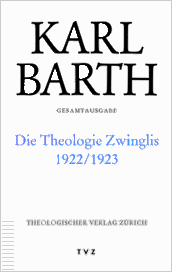
  Barth’s critical attitude towards Zwingli is fairly well known: he said unkind things about Zwingli in his letters to Thurneysen, and in particular he tried to establish damning connections between Zwingli and nineteenth-century liberal theology. But in these lectures, Barth also has some appreciative things to say about Zwingli, and particularly about Zwingli’s relationship to Luther.
 Here at Faith and Theology, the new blog of the week is


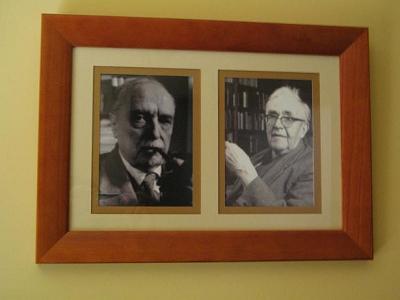

 I have compiled here a list of most of my posts on Eberhard Jüngel.
 In response to my recent post on Bultmann, Sean du Toit has admitted—shockingly enough!—that
  “If ... all true theologians also participate in the leadership of the church, and all who are active in church government live also within the theological arena, it follows that both an ecclesial interest and a scientific spirit must be united in each person.... If the opposite were the case, then the scholar would no longer be a theologian.... Likewise, the clergyman’s activity would lack both the skill and the foresight of good leadership, degenerating into a mere muddle of attempted influence.”
 Mike Bird and I don’t quite see eye to eye when it comes to Rudolf Bultmann. Once before I have
  It’s time again to announce the blog of the week. This week, the only possible choice is of course Jim West’s
  Althaus notes the complex problems which surround the Jesus tradition, and the difficulty of achieving historical certainty about Jesus. He notes that the Jesus tradition “has been shaped by apologetic and dogmatic considerations” so that it has “legendary features”; that the boundary between “genuine” and “fictitious” words of Jesus is uncertain and fluid; that the primitive Christians not only modified Jesus’ words but also “added alien elements to them” and sometimes even “transformed them” altogether (p. 72).
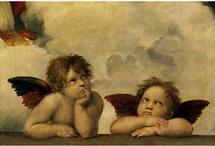 My least favourite section: §51 in III/3—Barth’s doctrine of angels. Admittedly Barth’s angelology is both theologically and exegetically the best ever attempted (and it’s the only significant angelology since that of Thomas Aquinas). And admittedly, in spite of all Barth’s polemic against Bultmann, the angels in the Church Dogmatics are still relatively non-mythological beings. Nevertheless, I can’t help feeling uneasy about this or any angelology; and I can’t help wondering whether Bultmann’s hermeneutic might in fact offer a better guide to interpreting the biblical angels.
 Well, as promised, I have offered my
  The Anglican Archbishop of Sydney, Dr Peter Jensen, is currently delivering the
  It’s time again for Faith and Theology to announce the new blog of the week. This week our winner is
  Recently
 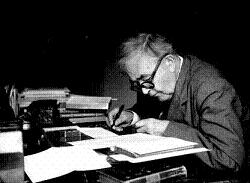 Karl Barth’s
 It’s time again for Faith and Theology to announce the blog of the week. With so much
 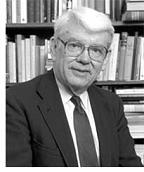 “[T]radition is a power for liberation, setting one free from the dictatorship of the claim that his own time or culture or school is the goal toward which history has been moving.... Tradition in this sense is the very opposite of the traditionalism that uses the dead theories of the past as a club to beat down all creativity in the present. Authentic tradition is a function of the critical memory and the creative imagination.”
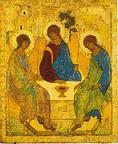 Back in October a reader informed me of a new article about Robert W. Jenson in
  I’ve been flicking through the latest
  One of the most creative and penetrating studies in the doctrine of God is Robert W. Jenson’s early book, God After God: The God of the Past and the God of the Future, Seen in the Work of Karl Barth (Indianapolis: Bobbs-Merrill, 1969). Although the title suggests that this is an exposition of Karl Barth’s thought, it is really Jenson’s own provocative interpretation of the doctrine of God, using Barth as a dialogue-partner and foil.
 There has been some discussion of the problem of faith and history over at the
  (1967) is one of my favourite little books. Ebeling was one of Rudolf Bultmann’s pupils, and his conception of faith and history is essentially Bultmannian, with the added refinement of Ebeling’s concept of the “word-event.”
 There was some discussion here recently about
  Peter Leithart offers
  Scot McKnight raises the
  Thanks to
  “The historical approach to Biblical literature is one of the great events in the history of Christianity and even of religion and human culture. It is one of the elements of which Protestantism can be proud. It was an expression of Protestant courage when theologians subjected the holy writings of their own church to a critical analysis through the historical method. It appears that no other religion in human history exercised such boldness and took upon itself the same risk.”


