Showing posts with label Balthasar. Show all posts

Sunday, 29 March 2015

Heretical typos: von Balthasar's Origen

Where copyists are concerned, Origen was the unluckiest of all the church fathers. Rufinus complained that heterodox copyists had cunningly inserted heresies into Origen's writings. They "poured the poisonous filth of their own doctrines" into the texts of Origen in order to give their ideas a false aura of authority and antiquity (Rufinus, On the Falsification of the Books of Origen, 2). When Rufinus translated Origen into Latin at the end of the fourth century, he scrupulously omitted or erased anything that looked like a heretical interpolation. As he says in the preface to his translation of First Principles: "Wherever I have found in Origen's books anything that contradicts the devout statements he makes elsewhere about the Trinity, I have either omitted it as a corrupt and interpolated passage, or reproduced it in a form that matches the doctrine that he often affirms elsewhere." And then Rufinus adds that he has also made some interpolations of his own, inserting "explanatory comments" wherever Origen's "obscurity" calls for expression "in a fuller form" (Rufinus, Preface to First Principles).

Poor Origen! Interpolators on every side! Well, Christian reader, I'm sorry to be the one to break the news to you, but the bad luck of this great teacher has continued right down to our own time. One of Origen's greatest modern defenders, Hans Urs von Balthasar, inserts a very peculiar heresy into Origen's soteriology:

"... and by his death destroyed life."
Quotation from Origen in Balthasar, Origen: Spirit and Fire, p. 184.
To be more precise, it is Balthasar's English translator Robert J. Daly who has inserted this latest heresy into Origen. I am not certain, but I believe it may have something to do with Daly's unwholesome fascination with sacrifice.

If only Rufinus were here, he would have tidied things up quite nicely and removed every trace of heresy – something like this (translated freely from Rufinus' Latin):
For although the only-begotten Son of God, whom the holy church acknowledges homoousios with the Father before all worlds, became truly human and suffered for the salvation of the human race, and by his death destroyed death (for let all those who claim that Christ's death was a destruction of life be accursed), and by his resurrection restored life, just as marvellous, apart from the incarnation of the eternal self-subsistent Word, were the things brought about by the Holy Spirit, who is worshipped and glorified with the Father and the Son, world without end.
Thursday, 22 January 2009

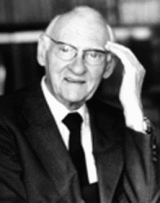
Hans Urs von Balthasar on writing and living

The other day, a friend gave me a very charming little book by Hans Urs von Balthasar, My Work: In Retrospect (Ignatius, 1993). It includes some remarkable reflections on the processes of writing – including the following, on the gap between one’s life and one’s writing:

“It is not possible to make a clean separation between [writing and living]; a book must reflect much of the meaning that the writer seeks to give his own existence, even if this meaning is rather often stamped on the book against the direct will and supposition of the author…. Whoever has truly experienced this gives up the attempt to bring his literary work into harmony with his life; when he writes, he is ahead of himself in a dream of the totality in which he would like to give his fragments a sure home; then once more he limps along behind his own self, or even creeps backward and looks around, like Lot’s wife, into a beloved image of the past, an image that entices all the more magically since it is already ablaze. Who can keep up?” (pp. 17-18).

Saturday, 12 April 2008

Balthasar on writing

In her notes on the analogia entis conference, MM has one of the most touching theological anecdotes I’ve ever heard: “Martin Bieler recalled that Balthasar once told him personally that he (Balthasar) had written everything for Barth: ‘I wrote it all for Barth’.”

Saturday, 27 October 2007

Is God imprisoned in history?

Our friend Halden has just posted the latest instalment of his superb series on “radical trinitarianism.” The post is very relevant to the fascinating conversations we’ve been having here about Paul Molnar’s new book.

Halden speaks of “the primal revelation of God in and as the tortured, murdered, and resurrected Christ.” And he observes that “this event of cross and resurrection is the eternal God precisely as God-for-us and God-with-us” – in other words, the being of God is “constitutively manifested in the cross and resurrection of Christ.”

But does such an understanding imprison God within the world’s history? Halden provides a compelling answer to this question: “As Balthasar saw with perhaps more clarity than anyone in recent theology, the radical kenosis of the Triune God in the death and resurrection of Christ and the Pentecostal dispersal of the Spirit does not imprison the Trinity in the world’s fate, but rather lifts the world up into the embrace of the immanent Triune Life.”

This is a first-rate post which deserves a careful reading.

Monday, 9 April 2007

A metaphysics of beauty

“[I]f beauty eternally generates being, and if beauty impregnates being, then being is the eternal image or reflection of beauty. In this case, the relation between beauty and being might be called a mediated immediacy. In other words, the divine beauty might be understood as mediating itself through being. In being, beauty sees itself.”

—Stephen Fields, “The Beauty of the Ugly: Balthasar, the Crucifixion, Analogy and God,” International Journal of Systematic Theology 9:2 (2007), p. 183.

Sunday, 11 March 2007

Hans Urs von Balthasar and beauty

“Balthasar’s theological aesthetics begins with ‘beauty’…. That which appears in the beauty of natural and created forms is the glory of being, der Glanz des Seins. It speaks of the mystery of that which transcends and yet inheres in all existents. Consequently, aesthetics is not just one department of knowledge, which in relative independence of others constitutes a relatively autonomous discipline. When one sees the beauty of a person, a work of art, or a sunset, one is confronted at the same time with the mystery of its otherness. This sense of the wonder of beauty, Balthasar believes, is at the root of all serious metaphysical endeavor.”

—Louis Roberts, The Theological Aesthetics of Hans Urs von Balthasar (Washington, DC: Catholic University of America Press, 1987), 122.

Saturday, 10 February 2007

The humour of the saints

Al Kimel quotes Hans Urs von Balthasar on the humour of the saints: “But the saints are never the kind of killjoy spinster aunts who go in for faultfinding and lack all sense of humor…. For humor is a mysterious but unmistakable charism.”

Tuesday, 21 November 2006

David Bentley Hart among the Barthians

Speaking of duels, I’ve been really looking forward to hearing about the recent exchange between George Hunsinger and David Bentley Hart. Brian, David and Joshua have now posted excellent summaries of the session, and it sounds as though it was an interesting discussion. From the reports so far, though, I can’t help feeling that perhaps the criticisms of Hart didn’t quite get to the bottom of things: certainly Hart isn’t interested in replacing the mediation of Christ with “being”!

Instead of attempting the complicated task of directly comparing Hart’s analogia entis with Barth’s theology, perhaps it would be more illuminating to compare Hart’s conception with the formulations of the Catholic theologians Erich Przywara and Hans Urs von Balthasar – and then, via Balthasar, it might be possible to see how Hart relates to Barth’s famous anathema.

In any case, it’s good to see Hart’s work receiving the close attention it deserves.

Tuesday, 4 July 2006

Getting over Rahner?

Over at Pontifications, Al Kimel suggests that the Catholic Church needs to “get over” Karl Rahner. The Church’s future, he suggests, lies with Balthasar rather than Rahner.

Personally, I think it would be better to get back to Rahner. After all, hasn’t he already become a theological “classic,” i.e., someone whose books are always mentioned but never read? And is it a good thing if we “get over” a thinker like Rahner without first coming to terms with him for ourselves?

So although I feel perfectly happy about the current Balthasar renaissance, my own suggestion is that we should get “back to Rahner” as well—just as some Protestants (yes, even Barthian Protestants!) are now starting to get “back to Schleiermacher” in new and fruitful ways.

Thursday, 15 June 2006

Barth and Balthasar

In celebration of the 100th anniversary of Hans Urs von Balthasar’s birth, TVZ has published a new book exploring von Balthasar’s interpretation of Karl Barth and the contemporary ecumenical significance of this interpretation.

The volume, entitled Karl Barth—Hans Urs von Balthasar: Eine theologische Zwiesprache, is edited by Wolfgang W. Müller, and it includes essays by Müller, Béatrice Acklin Zimmermann, Martin Bieler, Thomas Krenski, Gottfried W. Locher and Werner Löser.

Sunday, 11 June 2006

The ecumenical requirement

“But the most important requirement for [the ecumenical] venture is that both partners in the dialogue have God before them and not behind them. All movement must be towards God, the depth of whose wisdom and mystery appears always to increase.”

—Hans Urs von Balthasar, Who Is a Christian? (London: Burns & Oates, 1968), p. 39.

Wednesday, 24 May 2006

For the love of God (2): Why I love Hans Urs von Balthasar

A guest-post by Fred from Deep Furrows

Christian tradition is like a French cathedral: one cannot come directly into its breadth, but must enter through a particular portal. When I encountered Hans Urs von Balthasar in his books, I was a college dropout with a love of reading and a faith that had persisted from childhood despite my confusion and lack of focus. In Balthasar, I discovered the heart of Western (literary) tradition in the person of Jesus Christ. And Balthasar also educated me to discover a way of living that tradition in my everyday life.

Balthasar showed me that the beauty of the Western cultural tradition is Christ, a beauty Who is symphonic and thus capable of bringing together a dazzling pluralism of temperaments. In his survey of Theological Aesthetics (Clerical Styles, Lay Styles), Balthasar explores the breadth and depth of this tradition through its most original and lucid representatives: Irenaeus, Augustine, Dionysius, Anselm, Bonaventure, Dante, John of the Cross, Pascal, Hamann, Soloviev, Hopkins, and Peguy. This chorus of voices cannot be systematized, but together they sing the diverse approaches to Christian beauty found in other authors.

Seeing the Form (Volume 1 of the Theological Aesthetics) set before me the ideal of the Christian form of life. For Balthasar, formation is based on the form of Jesus Christ found in the Gospels and encountered decisively in experiences synthesized in the Spiritual Exercises. Together with Adrienne von Speyr, Balthasar developed the theme of the Christian life as transparency to the splendor of Christ. This splendor is rooted in listening to the Word of God through Scripture (see Prayer), lived out by following the path that Jesus walked in coming to us (see The Threefold Garland), and expressed through missionary kenosis (see Mysterium Paschale and The Moment of Christian Witness).

Wednesday, 10 May 2006

Your favourite Catholic theologian

Of the 95 people who voted in the latest poll, 40% said they liked Hans Urs von Balthasar best, followed by 18% who preferred Hans Küng. Karl Rahner and the Pope were next with 16% each, while Yves Congar followed with 11%.

I found these results very interesting—I assumed that Balthasar would win (who could be stony-hearted enough not to love Balthasar?), but I also thought that Rahner would be a close second.

In the next week or so I’ll run similar polls to find out who are your favourite Reformed and Lutheran theologians as well.

Monday, 17 April 2006

Balthasar on Holy Saturday

I’m a few days behind with this one: but at Gaunilo’s Island there is a superb post on Hans Urs von Balthasar’s view of Holy Saturday. Balthasar’s work on this theme has been one of his greatest achievements.

Tuesday, 4 April 2006

Balthasar on paradox

A great post here by our brilliant friend Cynthia.

Saturday, 18 March 2006

Balthasar: the science of theology

“[I]t belongs to the essence of this and only this science that its scientific objectivity rests on the decision to believe, and that there can be, therefore, … no neutral objectivity, no consideration of the object of belief without belief, or apart from belief and unbelief.”

—Hans Urs von Balthasar, Convergences: To the Source of Christian Mystery (San Francisco: Ignatius Press, 1983), p. 51.

Note: See also the brief introduction to Balthasar at Per Caritatem.

Wednesday, 25 January 2006

Hans Urs von Balthasar: love alone

Hans Urs von Balthasar is best known for his big books; but I mentioned recently the great value of his little books as well. I want to post on several of these over the next few weeks. Today, let me mention the remarkable little volume Love Alone: The Way of Revelation (London: Sheed & Ward, 1970). At only 124pp., you can read the whole thing on a single bus trip across town (I did this myself just yesterday).

The volume offers a very condensed version of the argument developed in Balthasar’s massive work The Glory of the Lord. It is a work of theological aesthetics; and Balthasar uses the term “aesthetics” in a strictly theological sense: it is our perception of the glory of God’s absolute love expressed in Jesus Christ. The book’s central theme is that God is love, and therefore he is glorious—and we perceive this glory as beauty.

God’s revelation of himself is not only true and good, but also beautiful. The beauty of God’s love is the mystery of reality; it is the true meaning of life, of existence, of being. Just as we are overwhelmed by a beautiful work of art, so God’s love overwhelms us, transforms us, brings us to ourselves, and awakens us to respond to God with love.

Here’s a quote: “The first thing that must strike a non-Christian about a Christian’s faith is that it is all too daring. It is too beautiful to be true: The mystery of being, unveiled as absolute love, coming down to wash the feet and the souls of its creatures; a love that assumes the whole burden of our guilt and hate, that accepts the accusations that shower down, the disbelief that veils God again when he has revealed himself, all the scorn and contempt that nails down his incomprehensible movement of self-abasement—all this, absolute love accepts in order to excuse his creature before himself and before the world.” (pp. 83-84)

Thursday, 19 January 2006

Hans Urs von Balthasar: dare we hope?

The brilliant Roman Catholic theologian Hans Urs von Balthasar is best known for his vast theological trilogy, Herrlichkeit, Theodramatik and Theologik.

But reading Chris Tilling’s blog recently, I noticed that his wishlist includes Balthasar’s little volume Dare We Hope “That All Men Be Saved”? With a Short Discourse on Hell (1988). And seeing this book on his list reminded me of the immense value of even Balthasar’s smallest books.

Dare We Hope is a sharp and insightful work, and it deserves close attention regardless of one’s own view of the scope of salvation. The book evoked some controversy, with critics accusing Balthasar of universalism, i.e., of believing in the apokatastasis panton. But such an accusation misses the whole point of Balthasar’s argument—for he does not believe in universal salvation, but he hopes for it. And, as the whole of Dare We Hope demonstrates, there may be all the difference in the world between “believing” and “hoping.”

Archive

Contact us

Although we're not always able to reply, please feel free to email the authors of this blog.

Faith and Theology © 2008. Template by Dicas Blogger.

TOPO