Showing posts with label Hans Küng. Show all posts

Tuesday, 9 January 2007

The Spirit

“Palpable yet impalpable, invisible yet mighty, essential to life like the air we breathe, charged with energy like the wind of a storm – that is the Spirit.”

—Hans Küng, Der Anfang aller Dinge: Naturwissenschaft und Religion (Munich: Piper, 2005), p. 175.

Friday, 8 December 2006

Hans Küng's peace prize

As Chris Tilling notes, the great Catholic theologian Hans Küng has been awarded the Lew Kopelew Prize for his “tireless efforts towards a better understanding between the world’s great religions.” The prize is awarded for contributions to peace and human rights.

Thursday, 22 June 2006

What is a miracle?

As part of his ongoing series on Hans Küng, Chris Tilling discusses Küng’s view of miracles. According to Küng, we should focus on what the miracles in the Bible “mean,” without worrying about whether they actually “happened” historically or scientifically. Chris himself disagrees with Küng here, and he promises to offer a friendly critique of Küng in his next post.

Personally, though, I think Küng is basically correct: it is the meaning of an event that gives rise to the designation of “miracle.” Or, in the language of the Fourth Gospel, a miracle is a “sign”—it’s an event that “signifies” the act of God in history within the narrative context of God’s way with his people. Whether or not the event has violated the “laws of nature,” or whether or not the same event can be understood historically and scientifically, is really beside the point. The same event that is purely “natural” from the perspective of historical research may be truly “miraculous” from the perspective of faith—since the miracle-character of the event has nothing to do with the kinds of interpretation that are available to modern historiography.

I think Friedrich Schleiermacher had profound biblical insight when he offered this definition of miracles: “‘Miracle’ is merely the religious name for ‘event,’ every one of which, even the most natural and usual, is a miracle as soon as it adapts itself to the fact that the religious view of it can be the dominant one” (On Religion: Speeches to Its Cultured Despisers, p. 49).

The “religious view” of the event is the crucial thing; or, in other words, the interpretation of the event. The same event that can (and should!) be explained in secular terms by a historian is nevertheless a “miracle” when it is interpreted within the context of the narrative of God’s journey with his people in the Old and New Testaments.

Friday, 9 June 2006

For the love of God (12): Why I love Hans Küng

A guest-post by Chris Tilling
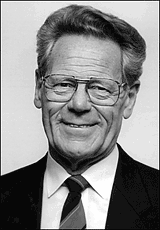
Somewhere Hans Küng has said something like this: “I want to be worldly enough that I can be of worldly use.”

Not the most convincing start to this post, admittedly, and the fact that I couldn’t find the exact quote has been driving me nuts. Alas, had I found it, I may even have sounded as smart as Kim and Cynthia, et al. But now, you know, I’m just a grumpy New Testament man masquerading as a theologian.

There is much that I could love about Küng: that he has engaged with an astonishingly broad spectrum of subjects; that his ecclesiology rings very well with my inner evangelical (with a focus on a proper appreciation of the New Testament heritage); or that his ecumenism strives laudably to approach years of religiously motivated bad feeling in open dialogue.

However, it is the opening words (mutters again at not finding the reference) that sum up, for me, why Küng is such a likeable theologian: he is a thinker for theological borderlands, for the questions that aren’t simply about the inner logic of Christian doctrine, for questions that don’t presuppose an already-in-place Christian faith.

He made this clear in his opening words in On Being a Christian (1974), but this is also seen in his open an honest engagement with questions of science, the existence of God, and how one can develop a reasonable faith in the “modern world.”

Moreover, highly significant is Küng’s engagement with the historical-critical method. The historical-critical method is so often overlooked or pushed aside in systematic theologies, as if it didn’t exist, as if its results were of no significance. But Küng has always had a feel for its importance. “Responsible faith today,” he argued back in the 70s, “presupposes—directly or indirectly—historical research.” The New Testament researcher in me punches the air!

However, Küng wants to engage in such open questions to serve the church and to inform its praxis. Naïve faith, he knows, can mean a life not lived in accord with the kingdom of God.

Of course, Küng is not perfect, and my words of praise might sound rather naïve in the ears of my Catholic friends. Also, his appreciation of the “modern frame of mind” may well be past its sell-by date. But what I love about Küng remains of vital importance to me and my personal development as a Christian—as I too want to be worldly enough to be of worldly use.

Thursday, 30 March 2006

Hans Küng and divine intervention

Via Pontifications, check out this interview with Hans Küng about theology and science.

When asked about the concept of divine intervention, Küng explains: “The word ‘intervene’ is not very good because it means to come in between. An intervention is usually something violent or aggressive. What I would reject is the idea that God could intervene against the laws of nature. I would even go further and say that for science, God is not a category because God by definition is a reality beyond time and space, and therefore does not belong in the world of our scientific experience.”

What do you think about the concept of “divine intervention”? I hope to post a series on this topic one of these days; so in the meantime, I’d be interested to know what you think about it.

Sunday, 19 February 2006

Hans Küng on theology and science

There’s a good article here about Hans Küng’s views on evolution and intelligent design. The article is in part a review of Küng’s recent book Der Anfang aller Dinge. For a more detailed discussion of this book, make sure you check out Chris Tilling’s excellent (and still ongoing) series of posts (1, 2, 3, 4, 5, 6, 7).

Wednesday, 8 February 2006

Hans Küng on Islamic violence

In an interview yesterday, Hans Küng discussed at length the current outbreak of violence over the caricatures of the Prophet Mohammed. Küng notes that the West shares some responsibility for this violence, and he rightly concludes: “Most urgently, the Palestinian problem must be solved.”

Küng has been a great supporter of Islamic-Christian dialogue, and in a few months he will release his monumental 900-page work Der Islam: Geschichte, Gegenwart, Zukunft, which is also due to be released in English translation as Islam.

Tuesday, 27 September 2005

Hans Küng and Pope Benedict XVI

On Saturday, Pope Benedict XVI met with Hans Küng and they engaged in friendly discussion for several hours. In particular they discussed Küng’s new book on faith and science, as well as his recent efforts to develop a global ethic (Weltethos). Küng and Ratzinger had not met since 1983, although they had been colleagues at Tübingen in the 1960s.

Küng is one of the world’s greatest living theologians; notoriously, the Vatican banned him from teaching in 1979. He has long been an outspoken critic of the Vatican, and back in April he lamented Ratzinger’s election as “an enormous disappointment for all those who hoped for a reformist and pastoral pope.”

But Küng described Saturday’s meeting with the pope as “extraordinary” and as “a very significant event”—especially in contrast to the fact that he had unsuccessfully sought an audience with the previous pope for 25 years!

For news reports, see here, here or here.

Sunday, 7 August 2005

Theological autobiography: Hans Küng

The best recent theological autobiography is—by a long shot—Hans Küng’s splendid work, My Struggle for Freedom: Memoirs(2003). This is not only a beautifully written, immensely engaging autobiography, but it’s also the perfect introduction to all Küng’s early theological work—his masterful books on Barth, Hegel, Vatican II, and ecclesiology.

Küng also offers penetrating insights into some of the most important theological developments in recent history—most notably, Vatican II. Through Küng’s eyes, you meet theologians like Karl Rahner, Karl Barth, Hans Urs von Balthasar, Yves Congar, Ernst Käsemann, and, not least of all, Joseph Ratzinger (now Pope Benedict XVI).

While this volume centres everywhere on the theme of “freedom,” the theme of the second and final volume of Küng’s memoirs will be “truth.”

Monday, 11 July 2005

Hegel and Theology

Hegel’s thought has profoundly influenced modern theology. This influence is often only implicit, but several theologians have sought to bring Hegel explicitly into the contemporary theological discussion. The most stimulating studies of this kind include:

Hans Küng, The Incarnation of God: An Introduction to Hegel's Theological Thought as Prolegomena to a Future Christology, trans. J. R. Stephenson (Edinburgh: T&T Clark, 1987); xv, 601 pp. This profound and wide-ranging exploration of Hegel’s theological thought focuses especially on Hegel’s vision of the historicity of God’s being. You can also find a crisp summary of the book's argument in Hans Küng, Does God Exist? An Answer for Today, trans. Edward Quinn (Garden City: Doubleday, 1980), pp. 127-188.

Eberhard Jüngel, God as the Mystery of the World: On the Foundation of the Theology of the Crucified One in the Dispute between Theism and Atheism, trans. Darrell L. Guder (Grand Rapids: Eerdmans, 1983); vxi, 414 pp. This brilliant work on the doctrine of God includes a detailed analysis of Hegel’s concept of the “death of God”, and of the significance of this concept for theological reflection.

Peter C. Hodgson, God in History: Shapes of Freedom (Nashville: Abingdon Press, 1989); 287 pp. This work offers a creative response to postmodern thought through a deep engagement with Hegel’s trinitarian and historical conception of God’s being. Hodgson is a leading authority on Hegel, and has been an editor and translator of Hegel's Lectures on the Philosophy of Religion.

And for a thorough exposition of Hegel’s theological thought, we now have Hodgson’s important new work: Peter C. Hodgson, Hegel and Christian Theology: A Reading of the Lectures on the Philosophy of Religion (Oxford: Oxford University Press, 2005); 318 pp.

Archive

Contact us

Although we're not always able to reply, please feel free to email the authors of this blog.

Faith and Theology © 2008. Template by Dicas Blogger.

TOPO